A new place can be a fresh inspiration in art. It’s easier to see what’s really there and feel curious and interested in a scene which you’ve never seen before – there’ll be fewer existing assumptions or pre-conceived ideas about it. You can enjoy that child-like experience of exploring and discovering, and it’s also an opportunity to find out what you’re interested in, so that you can consciously pay more attention to that.
How to find out what interests you? Start by wandering, and absorb. Let yourself relax, let what’s there flood in without judgment. Be curious and playful and notice where you want to look more closely.
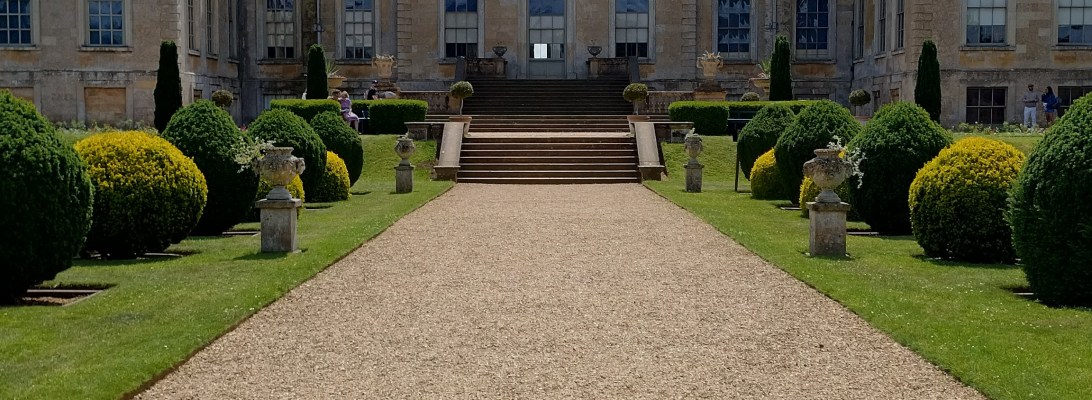
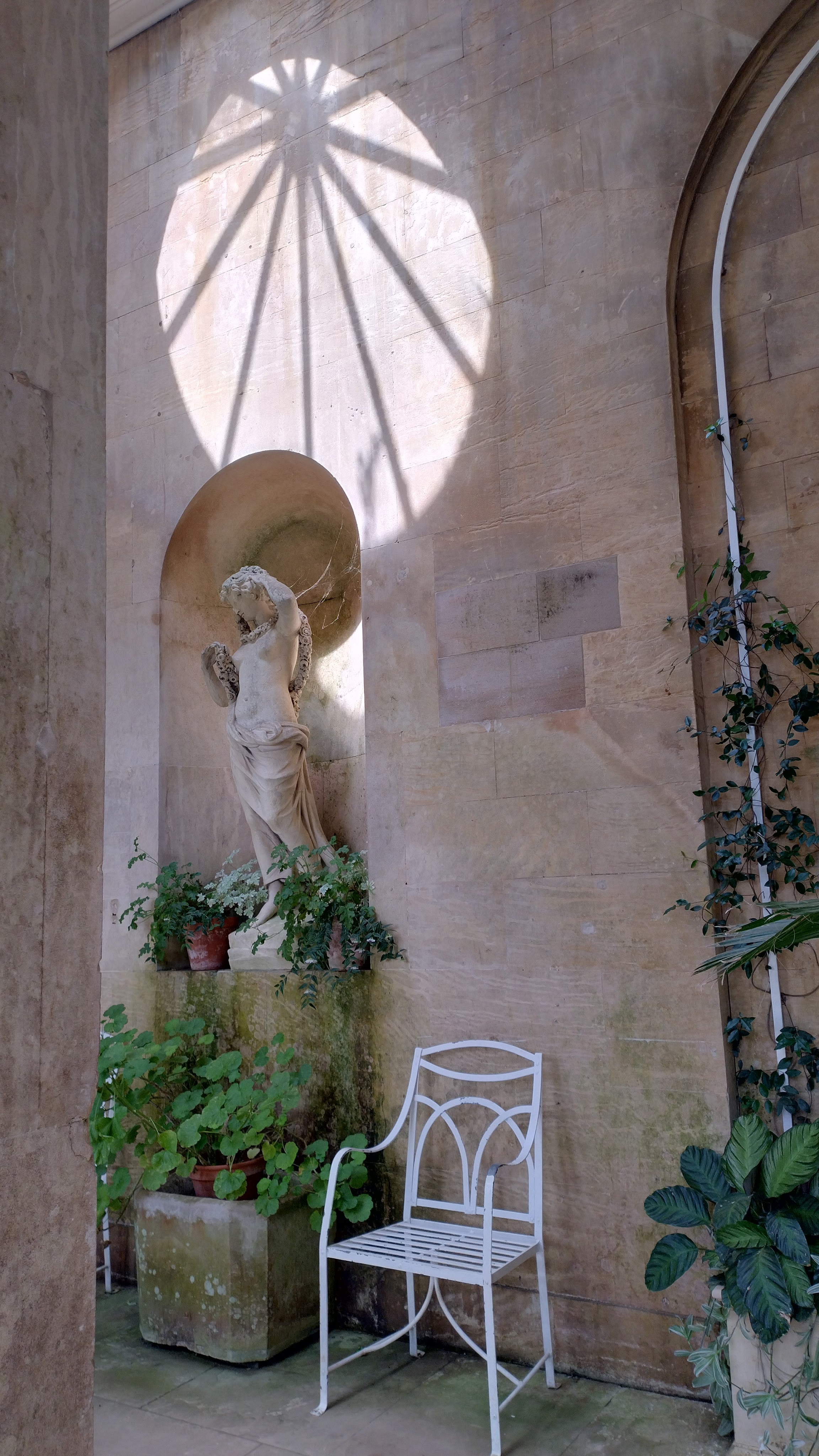
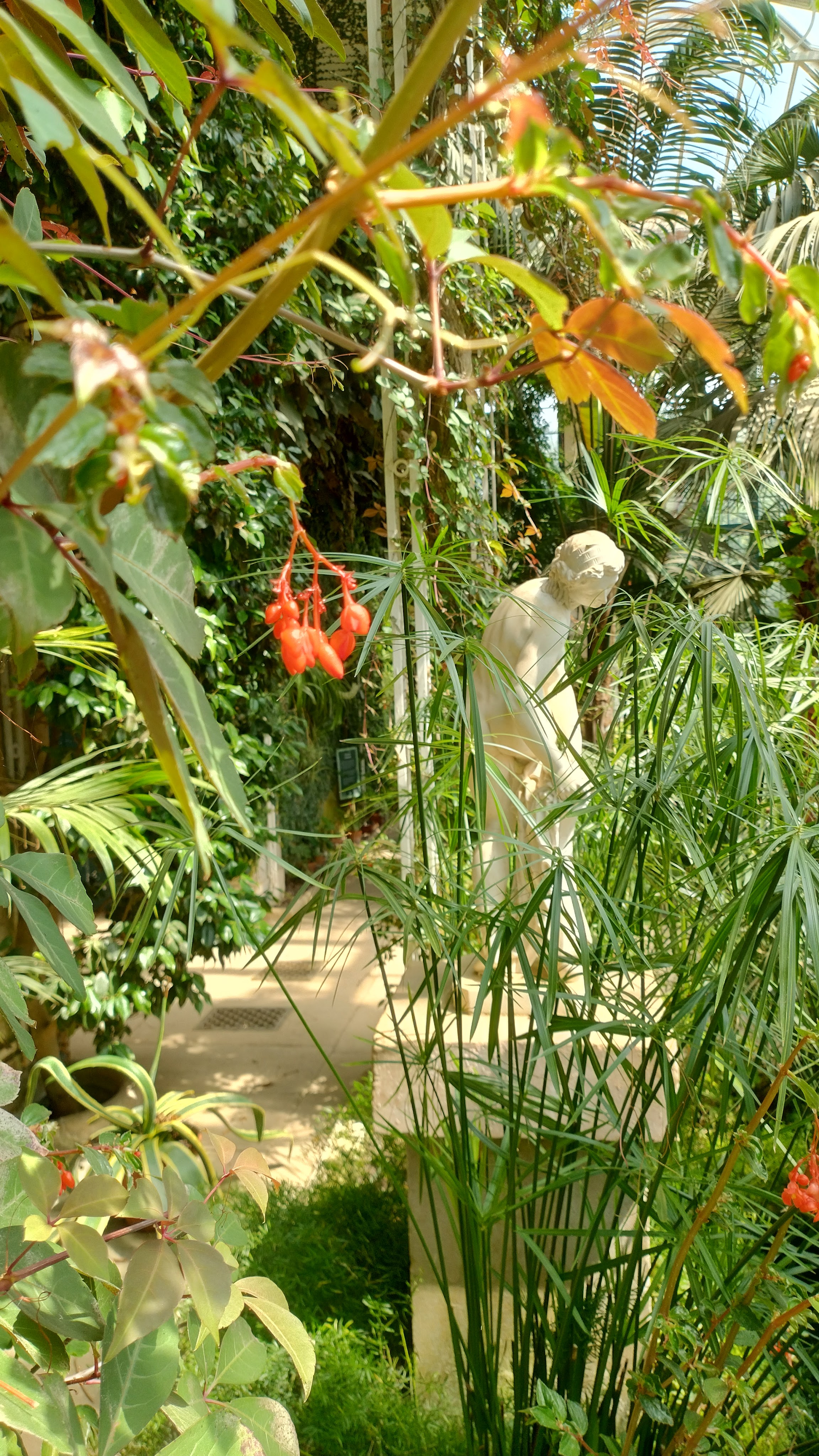
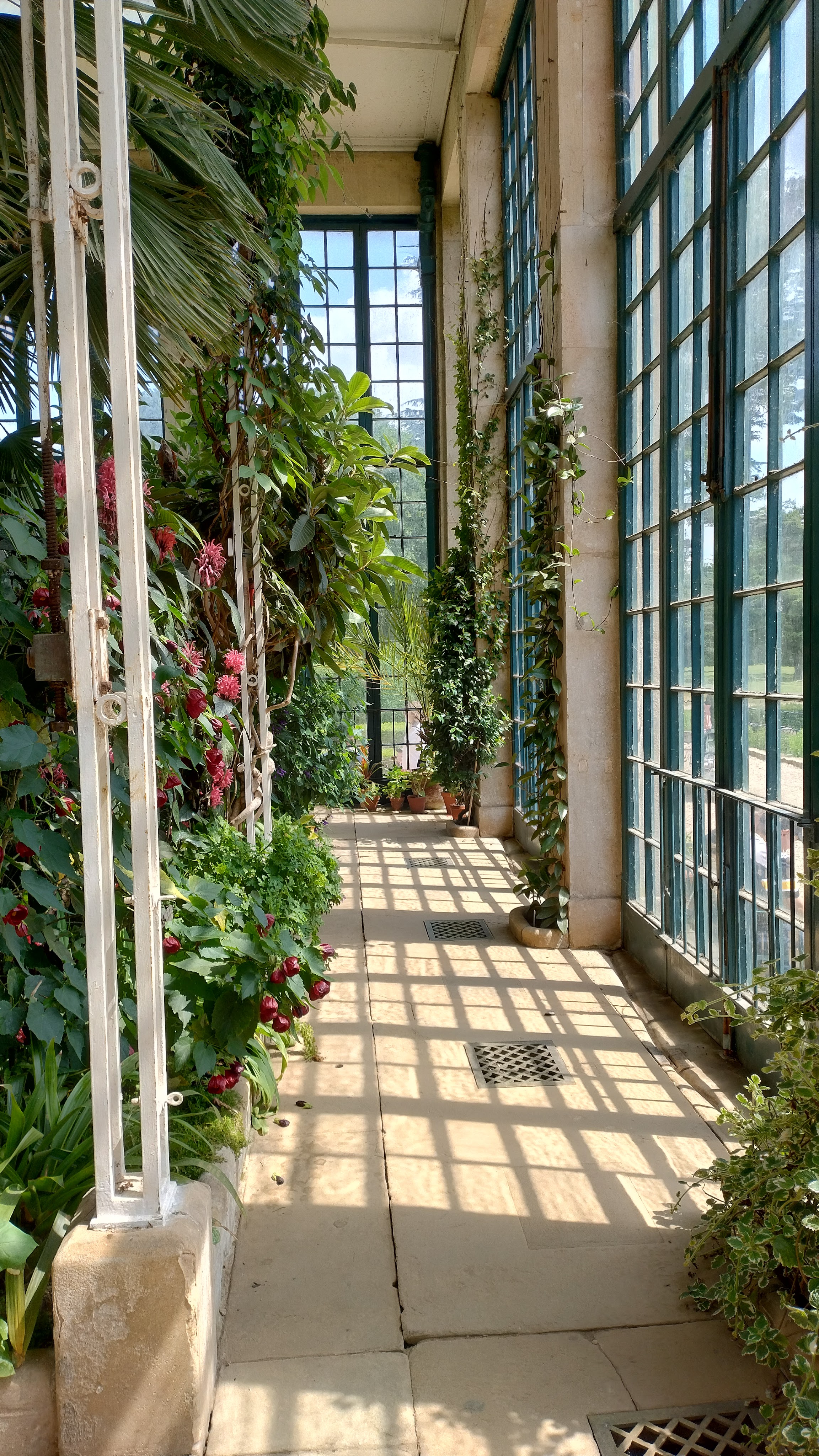
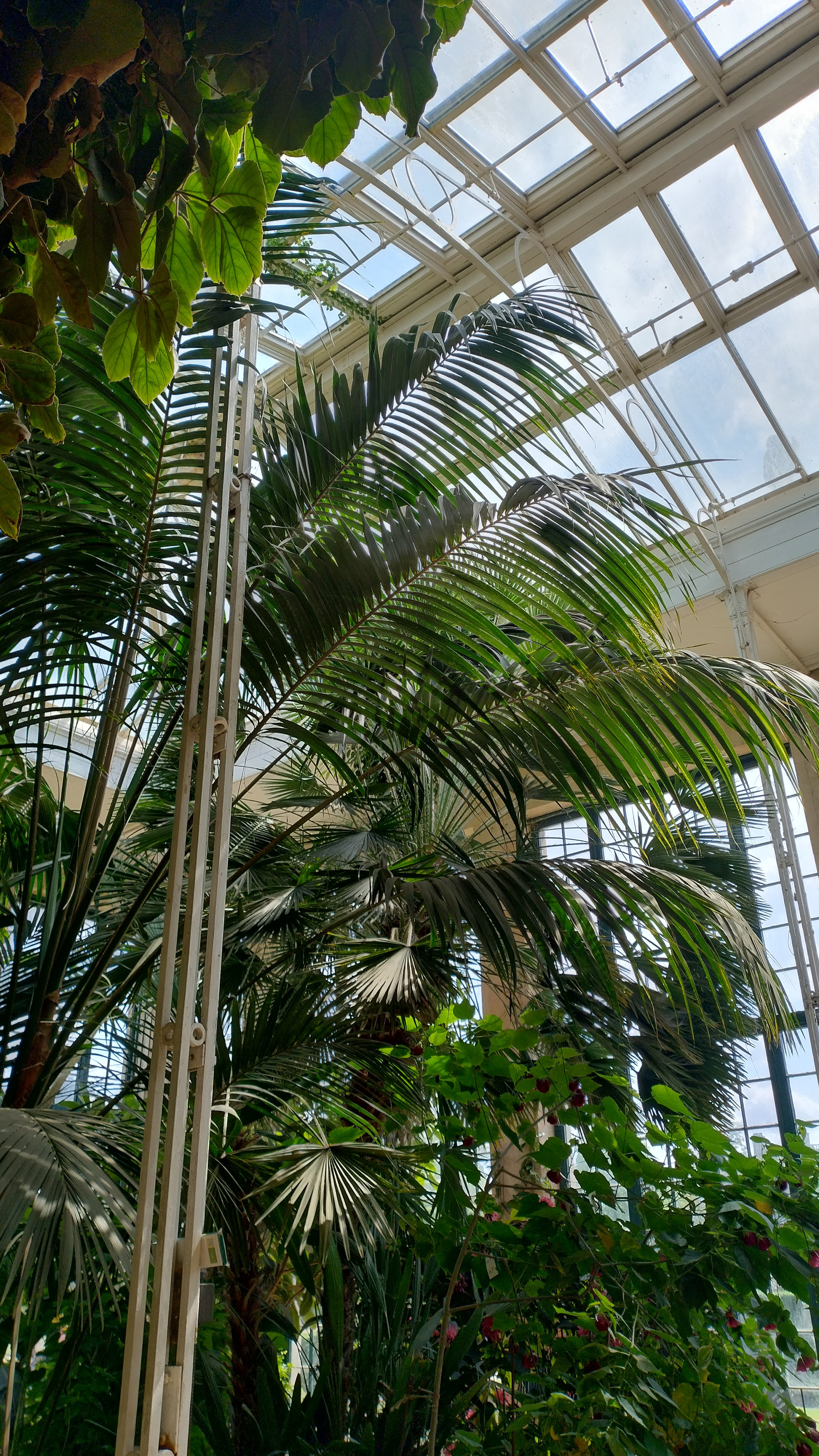
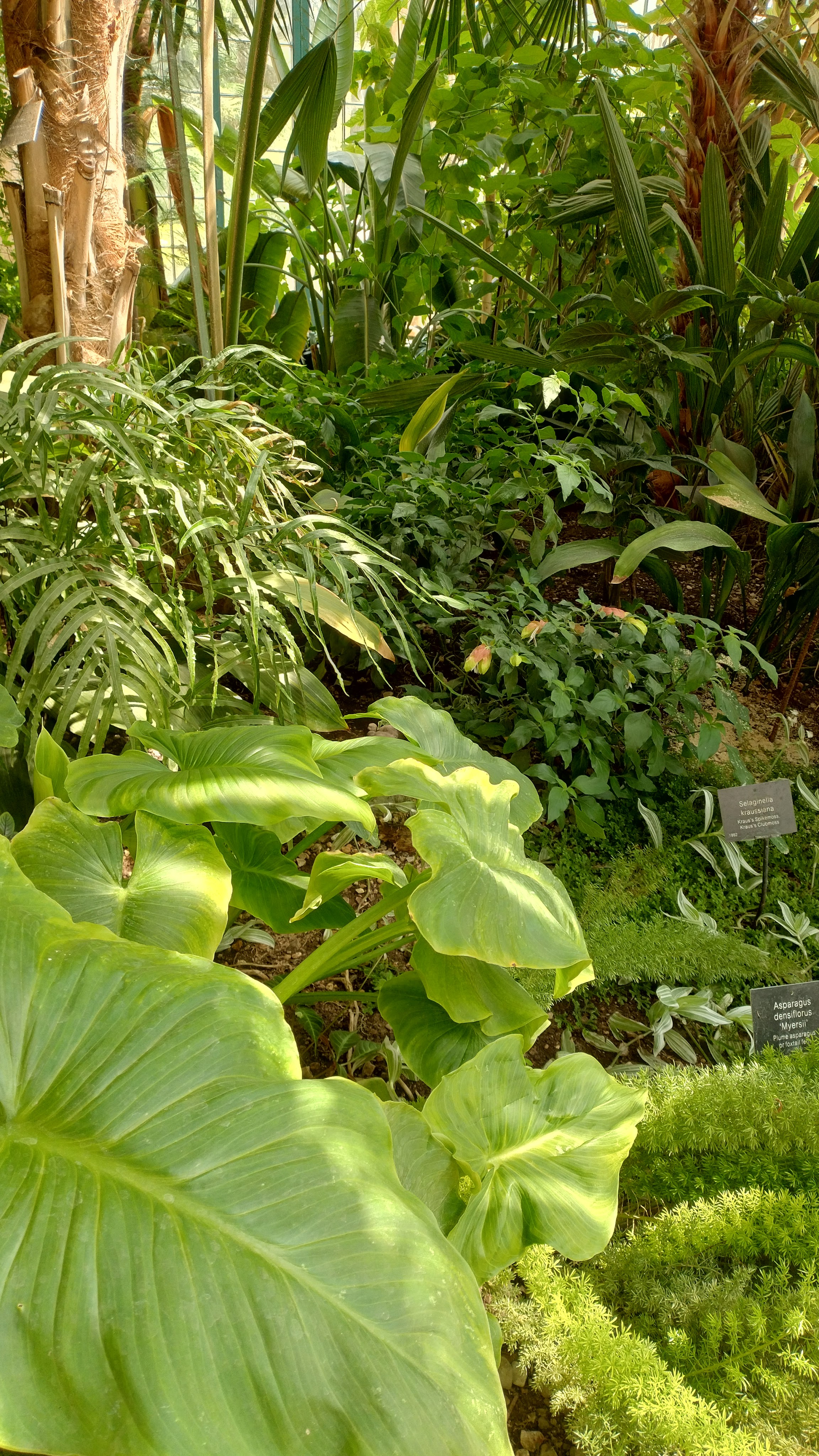
Wandering around the gardens at Belton, I found interesting contrasts and effects of light, patterns of foliage, shadows, different shapes, colours and strange things. The iron architecture of the conservatory gives structure to the green lushness and contrasts of the planting within. Windows give a frames work and let in light creating patterns on the walls and floor. It’s a sheltered indoor contained world of rare things, full of interest fro tiny details to how all the parts relate.
We will be playing with this process of drawing inspiration on the in-person drawing weekend I’m running in July. This year it’s located at Belton estate in Grantham, Lincolnshire. We’ll be based in the spacious and quiet venue of the old School in Belton village, and have access to the grounds and house of the estate.
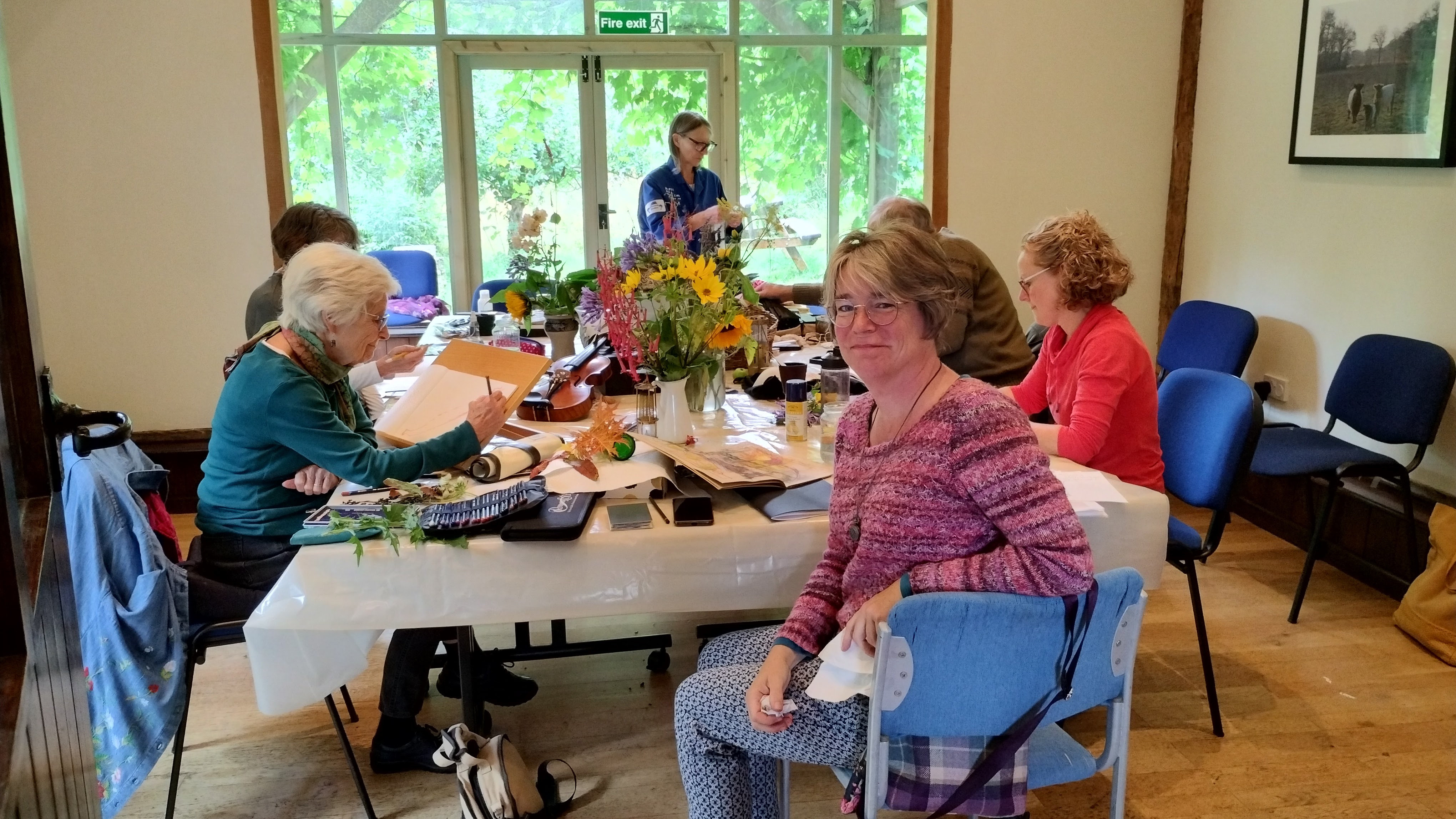
Particpants in previous years have valued the time, space and supportive atmosphere of this yearly drawing event. It’s flexible so that your csan pursue your own interests throught eh weekend, but we will start together and you can get guideance on your develop through the weekend. There are opportunities to socialise as well.
To find out more, and register your interest, follow the link below.
It’s mid-winter, and bitterly cold where I am. Snow, floods and ice are not enticing me out right now. It’s time to wrap up in blankets, get a hot drink and look for indoor inspiration.
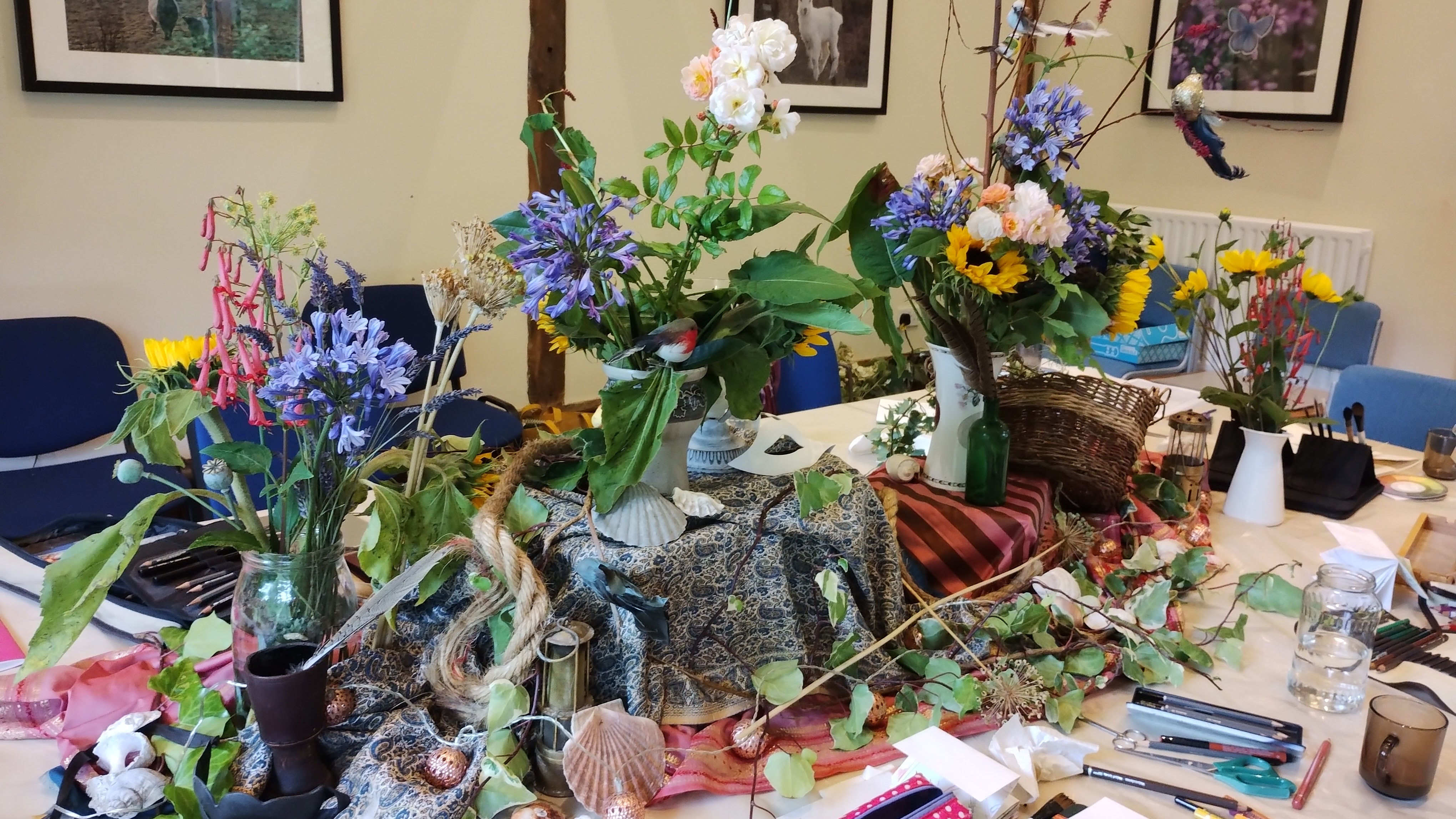
Drawing objects involves the same sort of decisions as any subject matter, in terms of shapes, space, colour and tone, contrasts, mood, balance, harmony and feeling. It’s also very accessible, and has a long pedigree stretching back into the past -artists have used objects from their surroundings as vhicles for their image making for ever. When you’re drawing at home, or joining me for a class, it pays to spend a bit of time gathering objects together which will be interesting to you, and provide opportunities for interpreting textures, exploring modelling, contrasts, and tone and colour.
Start with objects already around your home, in different shapes, sizes and textures. Anything is fair game for drawing! -a shoe, a candle stick, a cabbage, a bottle, a crumpled pillow case, the aftermath of dinner. Get curious about it, even if you’ve seen it a hundred times. Have you really looked, at the shapes, the surface, the angles? How could you indicate that texture, mix that colour?
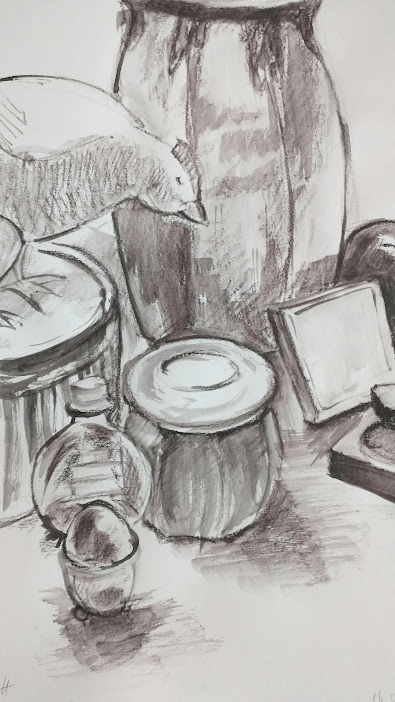
Objects organised in groups give you more to see and interpret, and are a way to begin playing with composition. In this grouping, there are a few ceramic pots with similar shapes but quite different sizes (repetition); there are contrasts of texture (variety), and the objects are grouped in such a way that the eye travels through them, they relate, like group of friends having a conversation.
Some artist stick with the same obects which appear over and over in their work through their life. Ben Nicholson’s striped and spotted jugs and mugs appear over and over throughout his art, but over time they transformed, he interpreted them afresh. You can read more about his still life collection here, at the Pallant House Gallery website.
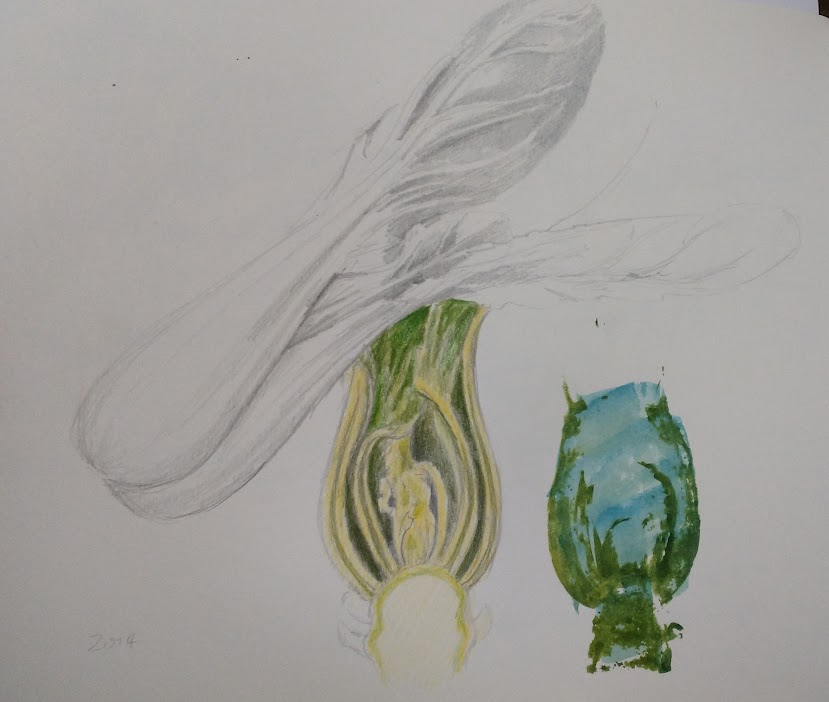
This idea might horrify you though. If you’ve been drawing the same things for years and are feeling stale, try looking eleswhere in your home for objects you haven’t spent time looking at. The veg drawer in the fridge is a good source of change (and often decay!) – there are often things in there or the fruit bowl in various states of freshness, and perhaps it changes by season and even variety. Apples will certainly change variety through the winter, with russets in autum, golden yellow matt skin, through to deep red flecked ones which are appearing now. You can cut and slice your fruit and vegetabels in different ways to create a new view. Below: Pak choi, drawing in graphite, sliced in half and observed in coloured pencil, then printed. The remains went in the stir-fry.
Small ornaments can make a good study by themselves. You never know how they may become involved in something else later on… like the animated objects in the 2017 Disney film of Beauty and the Beast (director Bill Condon), your possessions might take on imagined a life of their own.
JOIN IN: from 9th January 2025, Thursday Drop in Drawing at 7.30 PM London Time. Click here to find out more.
It’s been a busy few months; I’ve run two drawing summer schools this year, of very different sorts, and met some diverse and interesting people in each setting. One was more informal, the other more structured, but both about developing confidence and allowing people to grow their belief in themselves and their own creativity. I feel so lucky to spend time with my students, and their questions and conversations really stimulate and inspire my own thinking about art.
For the third year running, in July I hosted a small group in the lovely surroundings of Pucks Oak Barn in Compton, Surrey. It’s a beautiful green space surrounded by a woolly and wild community orchard, buzzing with insects and all sorts of plants; the weather was kind enough to allow us outside on Sunday, where particpants collected also sorts of interesting things from sensations to seedpods.
The focus was on creating space for each participant’s own practice, whatever they might need at this point – and we had a diverse group with varying levels of experience and wishes for what each wanted from the time. With such a small group I could work with each person and give individual guidance, so each could follow their path – and we had quite different results from the weekend: small folded books made of drawings, a giant collaged painting, colour charts and collaged concertina books.
It was a very relaxed time with lots of permission and encouragement to do whatever one felt like doing, including rest and chat!
For the first time this year I participated in the Royal School of Needlework’s International Summer School, the first to feature an art class. It was also my first time taching this back on site at Hampton Court since March 2020. A week later that year the country was locked down; the last session of that course was delivered on Zoom, and was the pioneer for live online classes for the RSN.
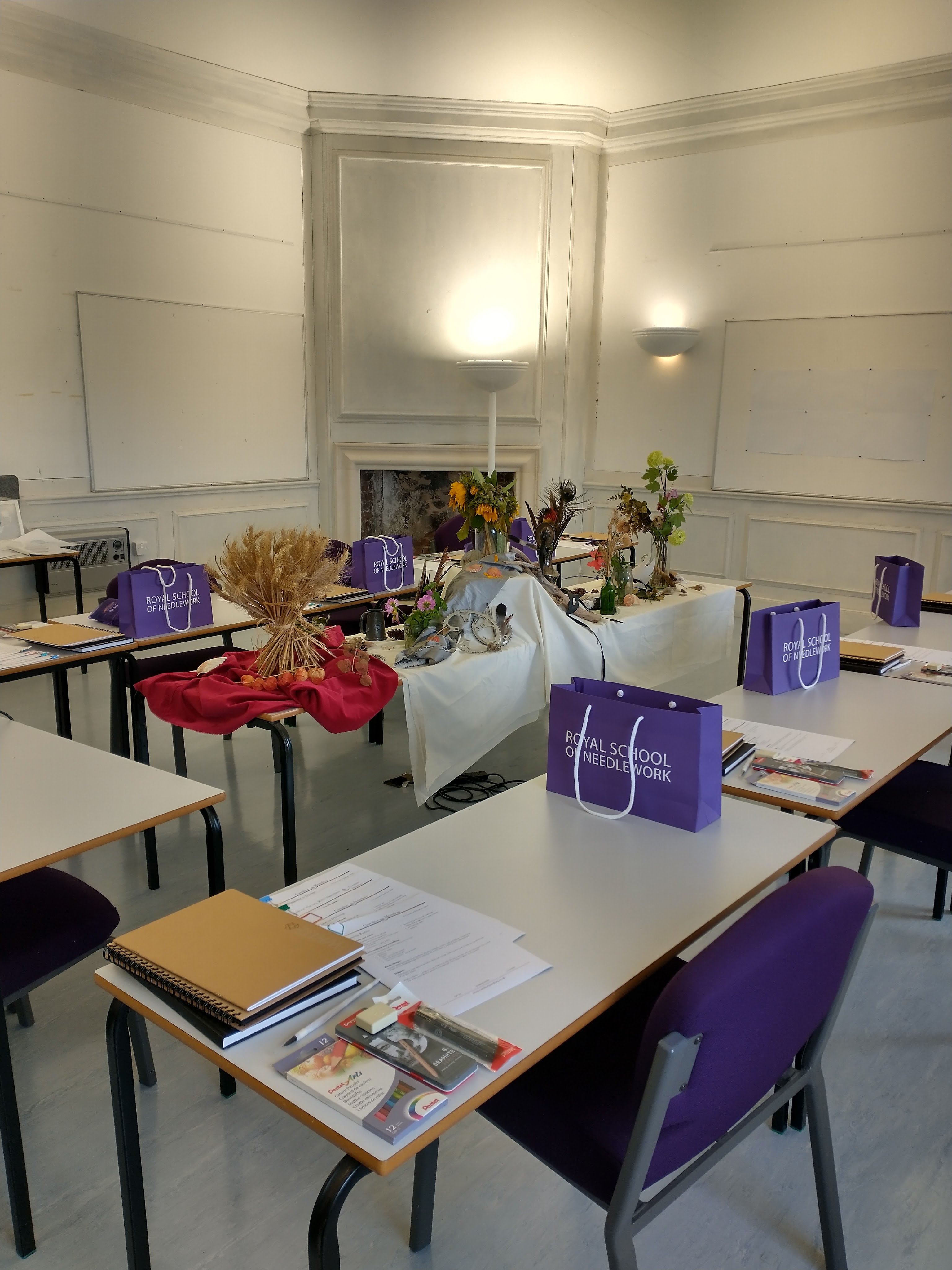
The classroom was beautifully prepared by Noleen, Education Manager, and I was very ably assisted by RSN graduate Future Tutor Sonia Lee. We had an intense week with eight students, looking at drawing principles from the beginning with lots to learn and lots of experimental processes amongst the more traditional artistic principles and processes. People are often surprised to discover that there are learnable structures and principles behind art, it’s not a magic process which you can do or not.
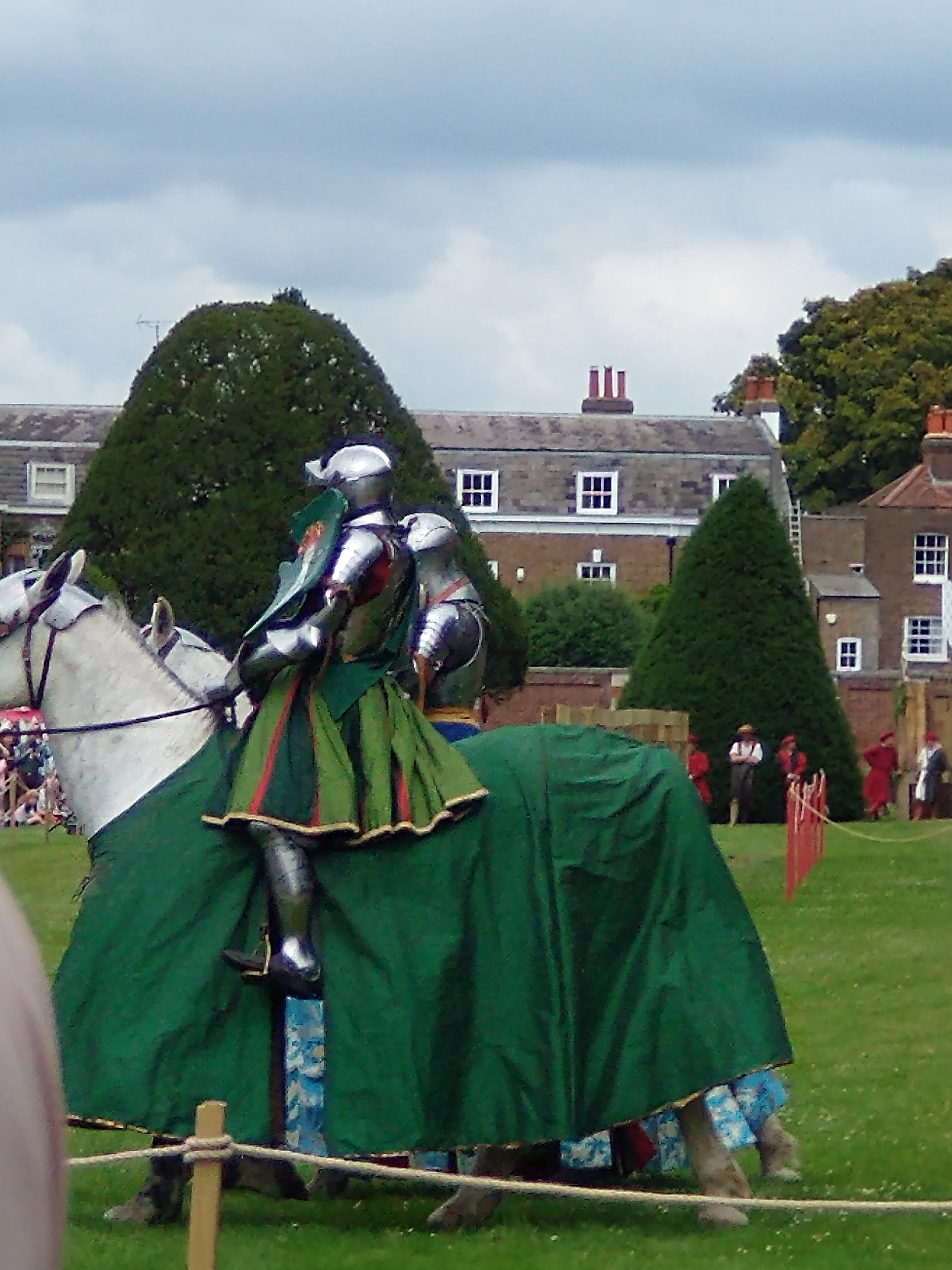
There’s always a lot going on at Hampton Court in the summer, with costumed intpreters and re-enactors doing their stuff in the kitchens, walking about the palace and jousting in the grounds. RSN staff and students had a special trip to Buckingham Palace to see the Coronation exhibition and the robes and screen on which RSN staff and students had worked. It was in all a super busy week with lots to learn, lots of complicated travelling arrangements and much to see and digest.
For me what tied both quite different teaching experiences together was the goal of enabling confidence and excitement for the students. I aim always to give encouragement to see more clearly, to experiment and to play, and permission, to follow wherever curiosity might lead, and believe in one’s own inner creative voice.
My greatest reward is when someone says: ‘I realise I can just do whatever I want with my art and try things, it doesn’t matter’. When they say ‘I believe now I can draw’. When they say ‘I see new things I didn’t notice before’.
Do you have lots of UFOs lurking? PHds? Unfinished objects, projects half done… and does it matter? After a few terms of experimenting and trying lots of different processes, the students in my weekly drop in drawing class have a lot of work which may or may not be ‘finished’. I’ve written before about the process of reflection in creating artwork. Is this a case of reviewing the work, reflecting on what’s been done and then adjusting or adding to it til it’s complete?
Depends what you wanted to achieve. Sometimes when creating it’s about working out through the process what works, and equally importantly, discover what doesn’t work in order to change it – or discard the first attempt (or the second, or third…). The drawing/designing and making process is different to the mode you need to be in when you evaluate something; you need a bit of distance from your creation to see it objectively. Distance can be literally holding it at arms length, or it can be time. Put the work on the wall for a while and look at it now and then, or get it out of its folder or open the sketchbook and have a look through later, when a few days, weeks or years have passed. If you can introduce this discipline of periods of reflection, and then revisting your work, things might move forward in a way you don’t expect. If you’re the sort of person who likes a folder full of completd things this might be uncomfortable! It might mean making yourself stop before it’s finished and give some time for the image and your ideas to be assimilated and coalesce.
I have a piece of work currently sitting on an easel because I dont know what it needs next – but if I wait, and look at it ocasionally, that might become apparent. It’s been through a few of these hiatuses already. I have other work that I might just leave as it is, half done and not looking like a finished thing. It might get re-used in some way or ultimately binned (pulped and remade by the borough rubbish collection service), or burned. At the moment for me it feels important to let myself not worry about making finished things. I am just beginning to feel like finishing one or two. And others I might like to try that process again…
How do you know if it’s finished? Give your work a bit of love. Try putting some L-shaped pieces of mountboard around it and see how it looks, given the honour and care of a frame. The only difference between a drawing shoved in a folder and a piece of art on the walls of a gallery could be your attitude, and a carefully chosen frame. Remember to sign and date it. (You can make up the date if you’re not quite sure…)
Sower of the Systems, 1902. GF Watts.
Watts Gallery Trust.
Finished? There’s no reason to suppose Watts thought it was anything other than complete, but… imagine yourself in front of this painting, still wet with paint, brushes in hand. Would you have stopped here?
GF Watts took decades to work on some of his paintings. He would return to them and alter them over long periods of time. The (admittedly enormous) ‘Court of Death‘ was started in 1870 and finished in 1902.
Picasso made 58 versions of the painting Las Meninas by Valezquez, each one exploring different aspects of the picture. Each one is finished, but there was still more to explore.
Even when you think you’ve finished, it might only be one part of a bigger idea.
This year I will be running my first retreat day, with Laura Murphy of mtc2. I will be publishing regular posts and other material about it, on my new blog ‘Reframe the View’. This blog will continue to be focussed on art making and learning. There’s an extract below from today’s post. If you enjoy it and would like to read about wellbeing and ways to nurture and support yourself, please go to ‘Reframe the View’ by clicking the button below.
The Stillness of Midwinter
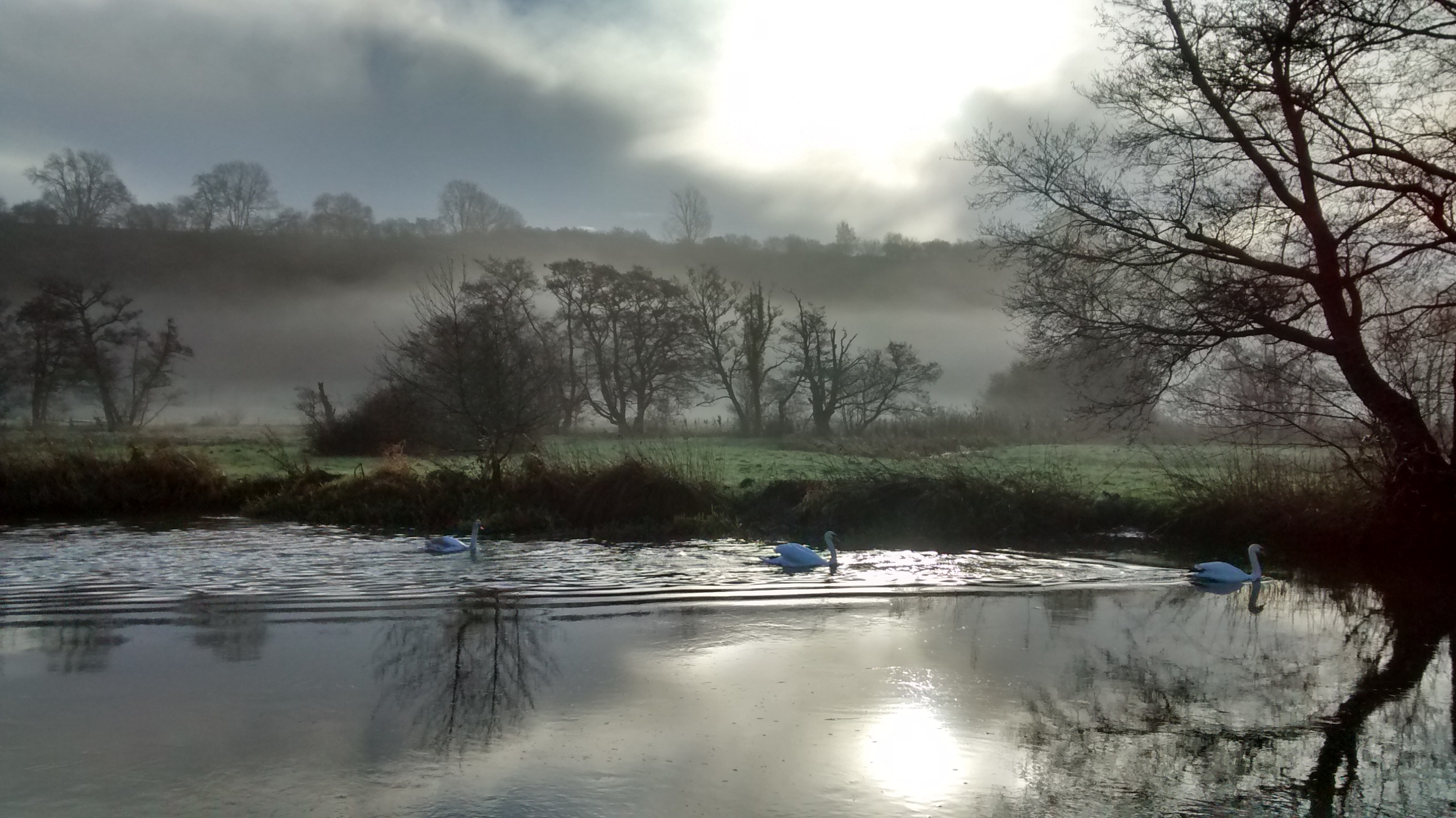
Today is a grey overcast day. It’s very quiet at home, with the sound of sporadic rain pattering against the glass and the ocasional breathy resonance of the windblown chimney. Not much is moving outside. Our feline neighbours are glimpsed darting across the garden and are gone -back home to curl up somewhere warm. Bulbs rest in the earth, their green spears nosing through when there’s a warmer day, but stopped when it’s cold and grey. Water is pooled on the meadows and lammas lands, with fleets of overwintering gulls, cormorants and the resident ducks and geese sailing in the shallow water. Twigs drip, tree trunks stained black with water. Their fat buds wait -for spring.
We are surrounded at the moment by stuff about renewal, reinvention, get fitter, get healthier and make resolutions. In the deep quiet of midwinter this increasongly feels out of step to me. Over recent years I’ve been paying more attention to the seasonal cycles and wondering how to align myself with them.
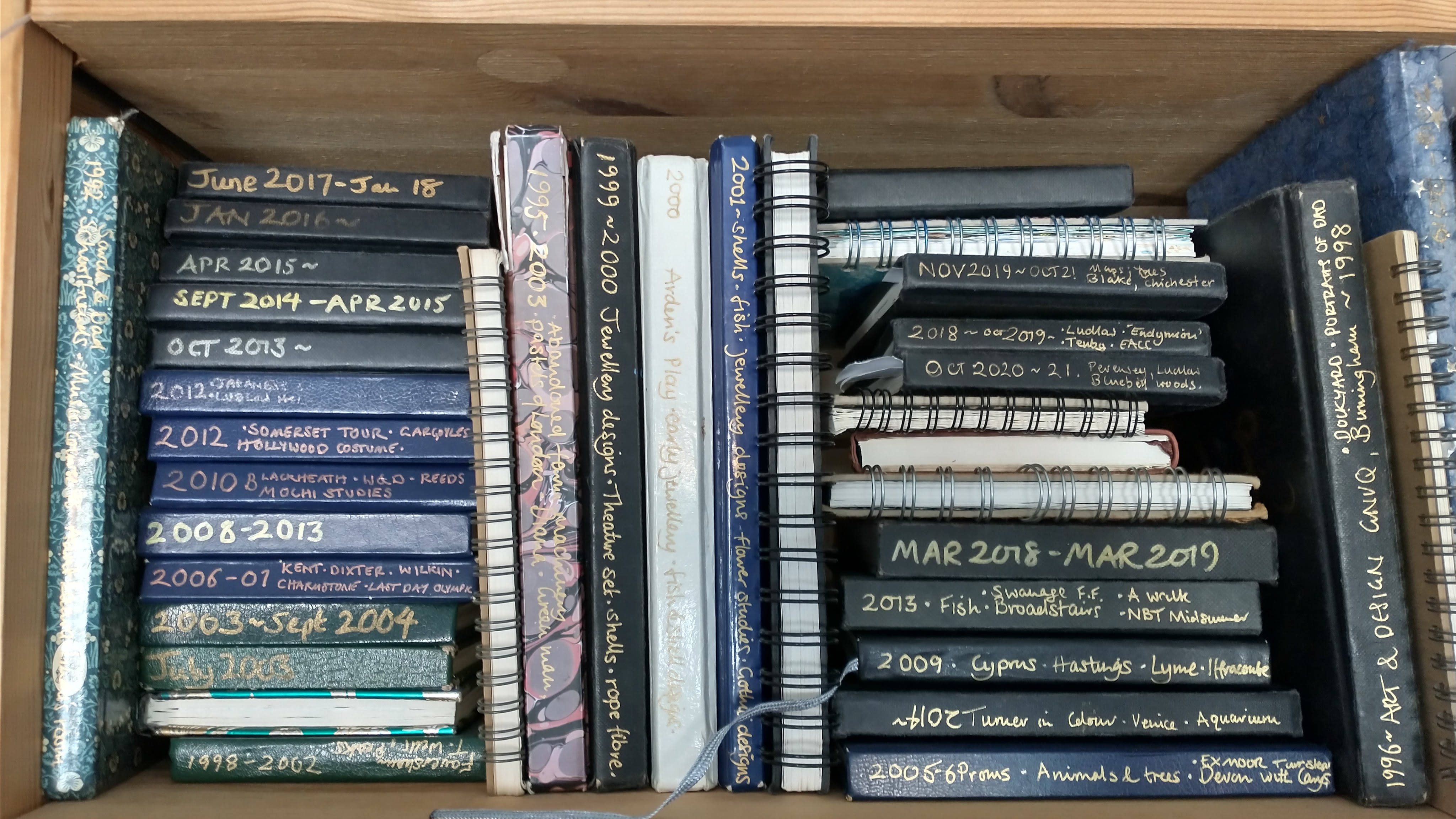
I effectively have two sorts of journalling: my sketchbooks which are very much drawn from and of the outside world, and written ones. There are lots more sketchbooks than written journals. The sketchbooks are on open shelves in my studio room, the journals are not. There are lots of drawings of places I’ve been, people I know (and sometimes people I don’t), some more detailed studies, rapid lines taken during a concert, studies made in museums, and sometimes written notes; it’s a place to record, remember and gather for future use. People look through my little sketchbooks sometimes but that’s ok because I don’t think they contain anything secret or controversial that I don’t want anyone to see. Most of the drawings were done in public anyway.
The journals are different. They are messy, written with no concern for spelling or grammar, not organised and sometimes illegible. These are not pretty journals; there’s no artwork or colour. Page after page of inky scrawl, which if you could unravel it, would be miles and miles of blue black thread which would probably go around the earth a few times. Often I write in a stream of consciousness which just goes wherever it needs to, and sometimes in more structured way around a question or a idea which has emerged. I write down reflections about my artwork: what I’ve tried and what I want to do next, which really helps me to pick it up again after a gap.
Sometimes I’m just dumping thoughts. I read them back later and that gives me some objectivity. It turns out that being able to do this for yourself has the added benefit of protecting your relationships from the strain of oversharing negative emotions (Kross, Chatter – The Voice in Our Head (and How to Harness It) p31, Vermillion 2022) without tiring the empathy of listeners.
I can then review it, giving myself the chance to consider it with some distance. Are there any negative assumptions underlying my reactions to something? Is there a different, more enabling way I could see it? What are the options for response, if any? Or do I need to just accept it?
Sometimes, on re-reading, I can find insights. if I repeatedly write about a problem, it flags up that there really is something I need to address. Coloured pencils come in for a bit of highlighting, things that pop out as important.
It’s also useful to write sometimes in a deliberate attempt to find the positive.What’s gone well today? what did I particularly enjoy, however small, or what am I grateful for? That can give me something to focus on when I wake up in the small hours ruminating.
Researchers are finding evidence of all these benefits in the practising of writing reflectively about one’s own experiences. It’s one of the practises being offered by Laura and myself on the Retreat Day we’re running next March. So if it’s new for you, give it a go and see how it changes things.
A few things to try:
setting a timer and writing in a stream for, say, 15 minutes.
writing down what you feel grateful for.
writing about an experience; who was there, what did you see, hear, smell, taste; what did you feel, what happened? Try writing it as if in the third person. Imagine you are observing yourself.
finding some affirmations and writing them down. This is very literally telling yourself that you’re worthy, deserving of love and affection, are capable, have talents – whatever it is that you need to hear to feel more safe, secure and supported, especially in areas where you feel vulnerable.
look up some journalling prompts. Specfic questions like: what behaviours do I want to grow? what do I want to stop doing? What new thing would I like to try? Who gives me support?
Research also shows that the benefit are felt over time, and that you don’t have to write every day to feel them. The important thing is to choose a way that suits you, and keep it private.
Working as an artist means a lot of time spent not knowing. I get an idea, or I carry out some experiments, but often I don’t know where they’re going, and whether the result will be something I’m happy with. There’s a lot of taking the next steps forward and remembering to trust the process, usually working in isolation, without knowing if anything of worth will come out of it – or whether it will be of interest to anyone else. There are still times when it can all feel rather uncomfortable.
As an artist and a teacher, I’ve had to get used to not knowing – my own, and other people’s.
The most important part of my role as a teacher is to support others through their uncertainty, vulnerability, and fears. To do this it’s crucial that I support myself – by taking time regularly: time out, and to reflect, and to consider if I need to do anything differently. This has similarities with how I assess a piece of artwork as it’s coming along. I need to pause every now and then, step back from the active making, and look at it.
I get relaxed, -sit back on my chaise long (it’s the guest bed futon really, but dressed up with blankets and my special cushion), with my tea, and the piece propped up. I allow myself to pay attention, in a soft focus sort of way, to what’s going on – with the piece, and in myself. It’s a sort of attentive waiting, allowing the space to see what pops up in response – to find out what’s going on under the noisy surface of the cerebral mind.
I can reflect on formal elements: colour, composition, proportion, balance, harmony. It might become apparent what needs adding, altering or taking away. More than one relaxing and looking session might be needed to arrive at the insights needed to move forward. That could be solitary time, musing and journaling, or it could involve talking it through with another. I like a mixture. It’s about creating the right conditions for the insights to arrive.
When the moment is right and the ideas appear, I feel a little surge of energy to take the next step, because I’ve got some clarity and confidence about what that should be. Quite often not beyond that, but the next step is enough. If, eventually, I am happy with what has appeared on my paper, canvas or fabric, then there’s the next step of putting it out in the world and finding out what others think. Putting myself out there, which is often scary.
Being an artist or maker of any sort has valuable lessons for living: in dealing with uncertainty, finding authenticity, finding out out what one wants to envision. It also involves dealing with fears that might block, and finding the courage to be fully oneself. Finding ways to cope – and to thrive- for myself has gone hand in hand with finding ways to support my students in whatever it is they want to achieve. It’s not possible to talk about art and not talk about life. Creativity is not only for artists. Those ideas and strategies for creating a vision and removing the block towards it are useful whatever you’re wanting to move towards
Finding ways to cope – and to thrive- for myself has gone hand in hand with finding ways to support my students in whatever it is they want to acheive. It’s not possible to talk about art and not talk about life. Creativity is not only for artists. Those ideas and strategies for creating a vision and removing the block towards it are useful whatever you’re wanting to move towards.
As a result, I’m bringing my experiences to a new venture. Next April, my friend Laura and I will be running a retreat day designed to give space, away from the noise of everyday life. We’ve chosen to set our day in the tranquil surroundings of a beautiful retreat house in Surrey. There’ll be time to relax, and settle into the beautiful surroundings of the studio. We’ll take time to reflect: with each other, talking, listening and journalling. There will be space to dream, using paper and colours. You will leave with tools to help you make choices and move forwards with whatever you want to grow in your life, as Spring surges into growth.
It’s just £60 to attend for the day. See below for more details and to register for a place.
It’s a common experience: there’s something you love doing, but you struggle to find the time, or the motivation, and you can get discouraged and then feel disappointed. There are some ideas from study about how people change which might help.
I learned recently that to change things you need to be consistent in what you’re aiming for, flexible in how you get there, and persistent in your efforts. There will be lapses and changes of direction, but continual steps and trying different ways of doing things will keep you moving forward, however small your actions are.
Of course, learning a skill is going to involve changing a number of things in your life. You’ll need to review and make decisions about in how you spend your time, perhaps change your priorities a little to make room for your interests, and if the skill involves a physical element like learning a musical instrument or making something, spending time developing it will create changes how you use your body .
So what is it you want to learn? How do you make space for it, and encourage it? And how do you keep motivated after the initial burst of enthusiasm or effort?
I’ve been learning to play the harp over the last 18 months. I had a burst of enthusiasm when I acquired it, and was less busy at the time (April 2021) so I did lots of research, found different teachers and resources online, and spent time getting to know it. I found a place to keep my harp to hand, so that I could just pick it up and play whenever I had a few minutes. Although I’m enjoying playing it by myself and experimenting, I wanted to check I was getting the basics right – you can hurt yourself playing an instrument if you dont take care about how you’re doing the repetitive actions. I decided to go on a weekend course. It was amazing to be in a great big room full of harps, talk to the owners, and hear very different styles of playing. That really opened up my eyes to the potential of this instrument. I came away with renewed enthusiasm and curiosity, still mostly playing by myself but now looking for ways to connect with other harp players.
I’ve realised more and more since the pandemic just how important it is to mix energy with other people, in positive, fun, friendly and supportive environments. It’s very important to me in my work too, and why I like to teach groups. We’re usually learning drawing and aspects of art together; the ‘together’ bit is really important. In a recent class for the Royal School of Needlework, we had a wonderful difference of interests and experiences, not to mention different cultural knowledge as well.
At the end of these classes I try to persuade people to think realistically about how to carry on with their learning. Set realistic goals: choose two or three short times a week to practise, keep your materials to hand and then review what happened after a few weeks. Have some intention about what you’re practising, which means think about it occasionally and choose what to practise baed on what you are most interested in and want to develop. Be prepared to change the timing, frequency and circumstances of when you practise. Accept that in busy times you may have to reduce or let go of your practice temporarily, and that’s ok. Return and renew the commitment when the time allows. Just don’t stop. Keep taking little steps. Consistent, flexible, persistent.
I run a regular drawing class online each week, for just this sort of encouragement. Short courses in drawing are also available, directly through me or oriented towards stitchers via the Royal School of Needlework. Click here to find out more: https://carolinehomfray.co.uk/drawing/
How to take the skills you’ve learned on a small scale into the outdoors.
Go on a small local expedition first.
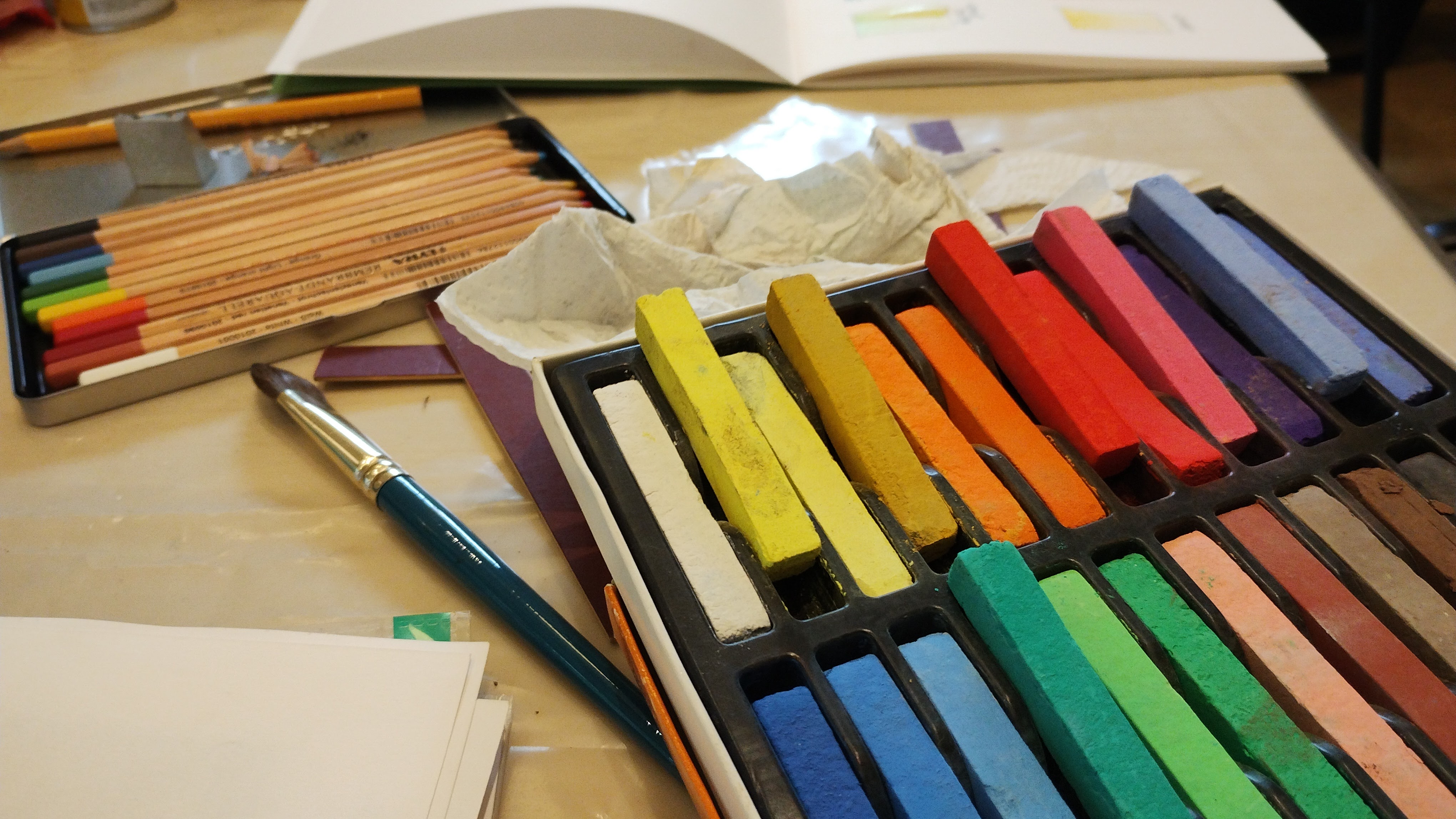
A Simple Kit. Take familiar materials which are convenient and easily portable. What are you most comfortable with? Perhaps just starting with a 2B pencil and small sketchbook is easiest – you can fit thos into a pocket. A little case of select coloured pencils? You can work with 12 and make most colours. Take a camera too, if you like to record information that way. It’s especially useful for things which are transient or in motion and are hard to capture without that magic of being able to freeze them in a photo.
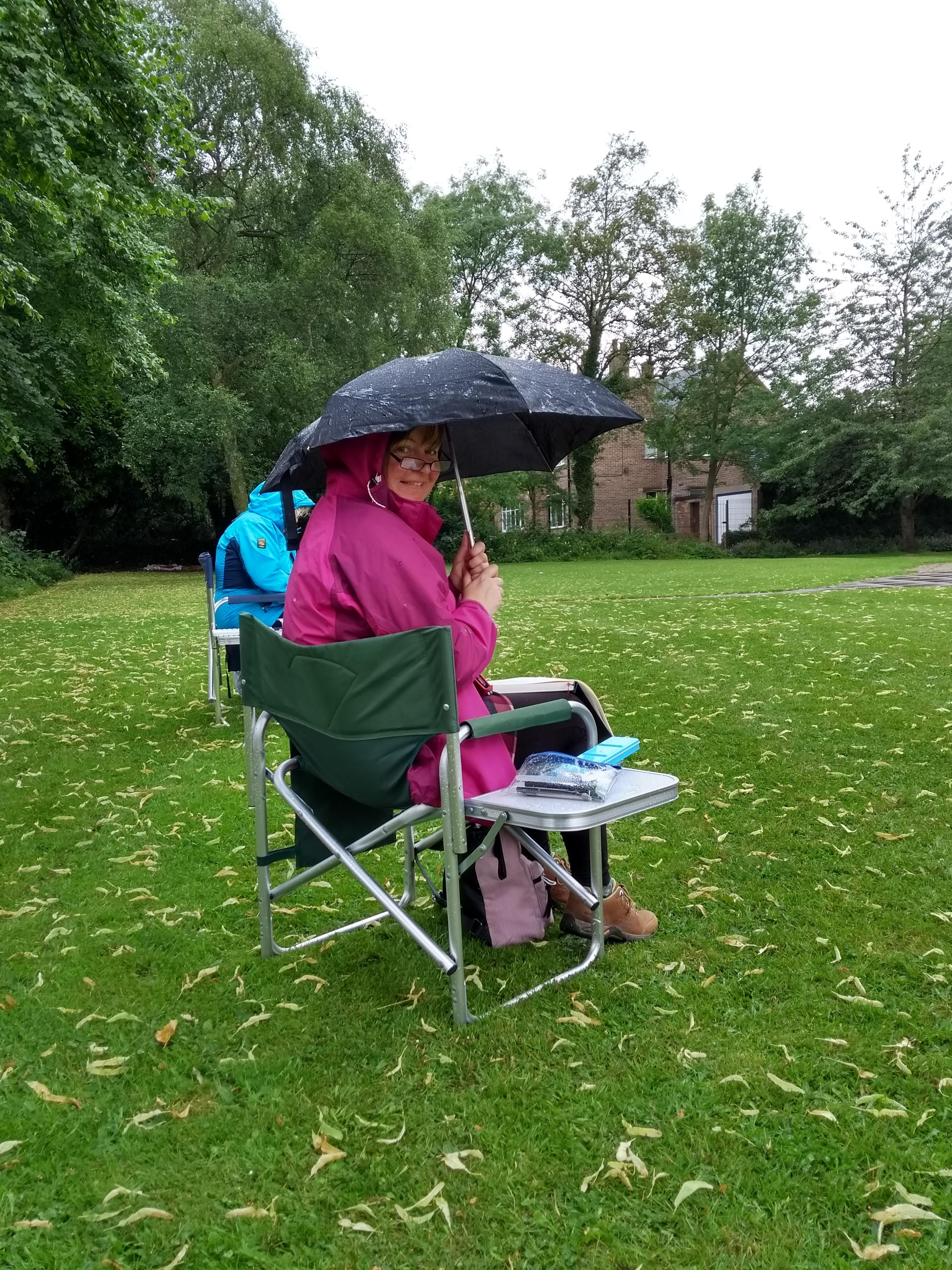
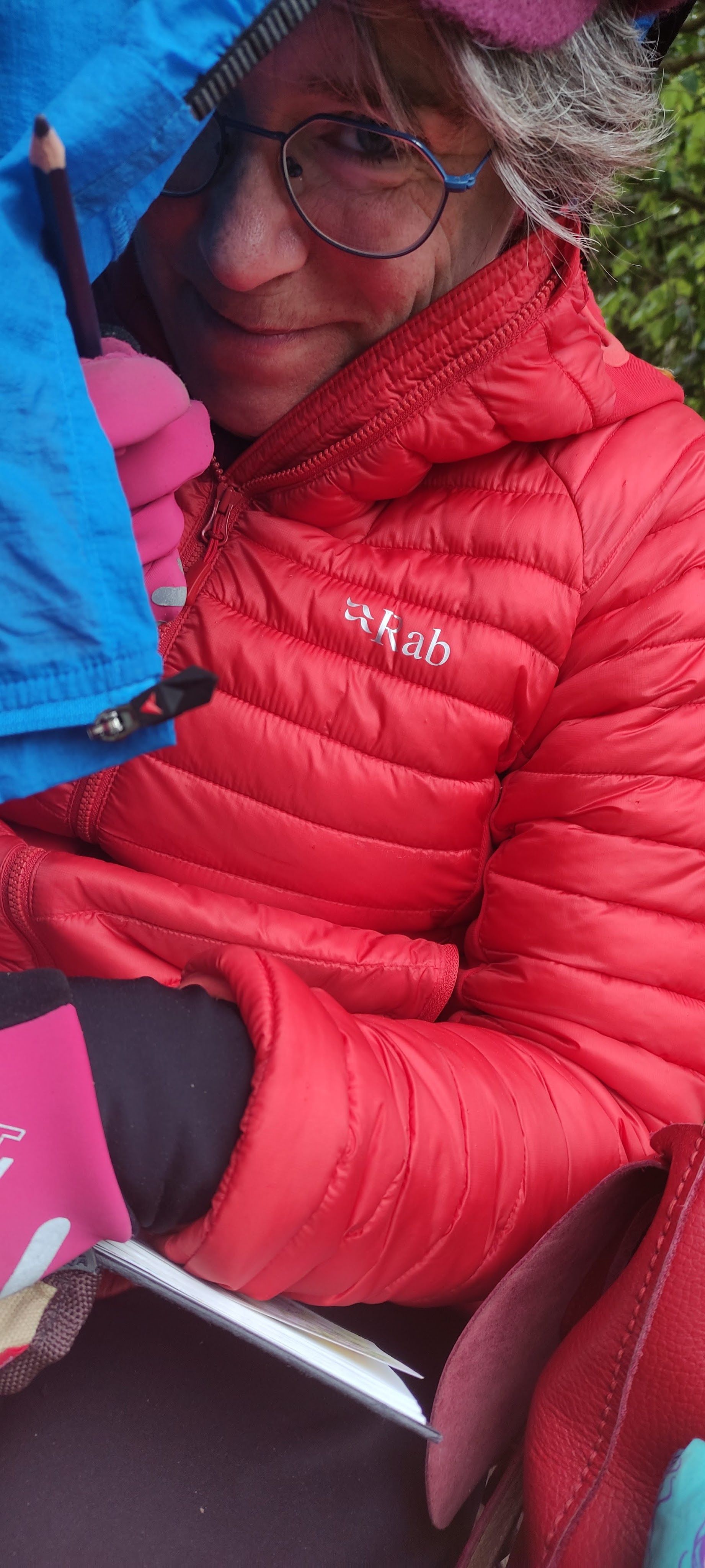
Clothing. Wear clothes and shoes or boots in which you will be comfortable, and will protect you from whatever elements are at play – whether it’s sun, wind, or even rain. Remember if you are standing for any length of time without moving, you will cool off, so might need another layer, thicker socks, a hat. How are you going to access your materials? A small bag or a pocket might be enough. Decide if you are happy standing or sitting on the ground; you could take a small stool, or something waterproof to sit on (I often sit on my waterproof trousers, or a carrier bag, on the ground).
Optional: portable cup of tea. I always take one! Some water is a good idea, especially in hot conditions. When drawing one can forget the passage of time and ‘come to’ feeling hungry and thirsty.
Sarah prepared for all weathersSome unexpected spots of rain – a coat over the head kept the paper dry!Plenty of layers hereDrawing outdoors means being prepared for different states of wet and dry, warm and cool. Sarah and I demonstrating outdoor kit.
Start walking. Amble, in a non-purposeful, easy way. You want to feel unpressured and be able to pay attention to what’s around you. One way to do this is to pay attention to your senses – not just sight, but scents, and sounds; the feel of the ground, the smell of the earth, the noise made by your footfall, and any sounds you can hear, whether wildlife or man-made. These can help you get into the ‘right mode’ way of being, which is optimal for creativity (see Betty Edwards, Drawing on the Right Side of the Brain, for more about that).
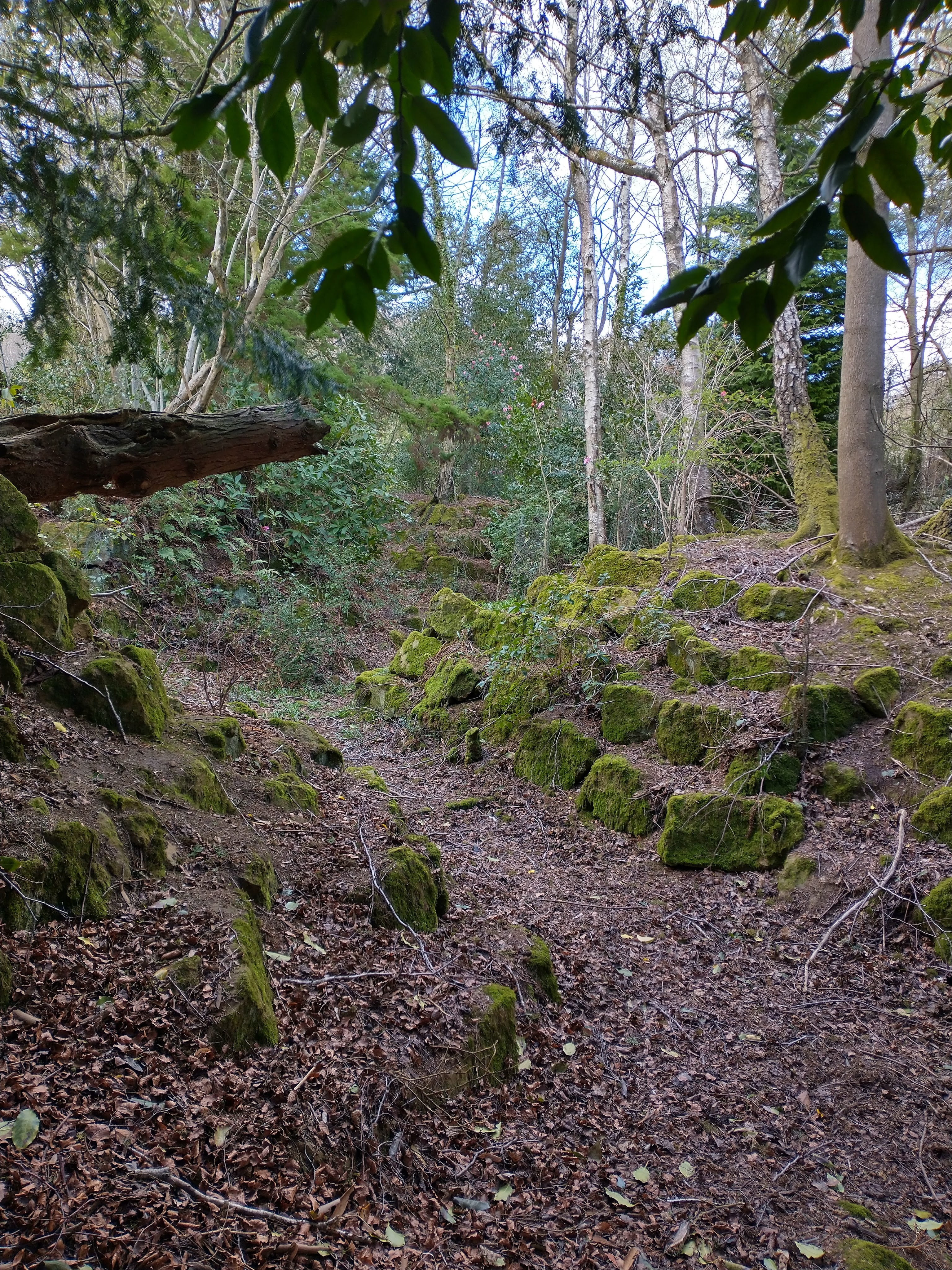
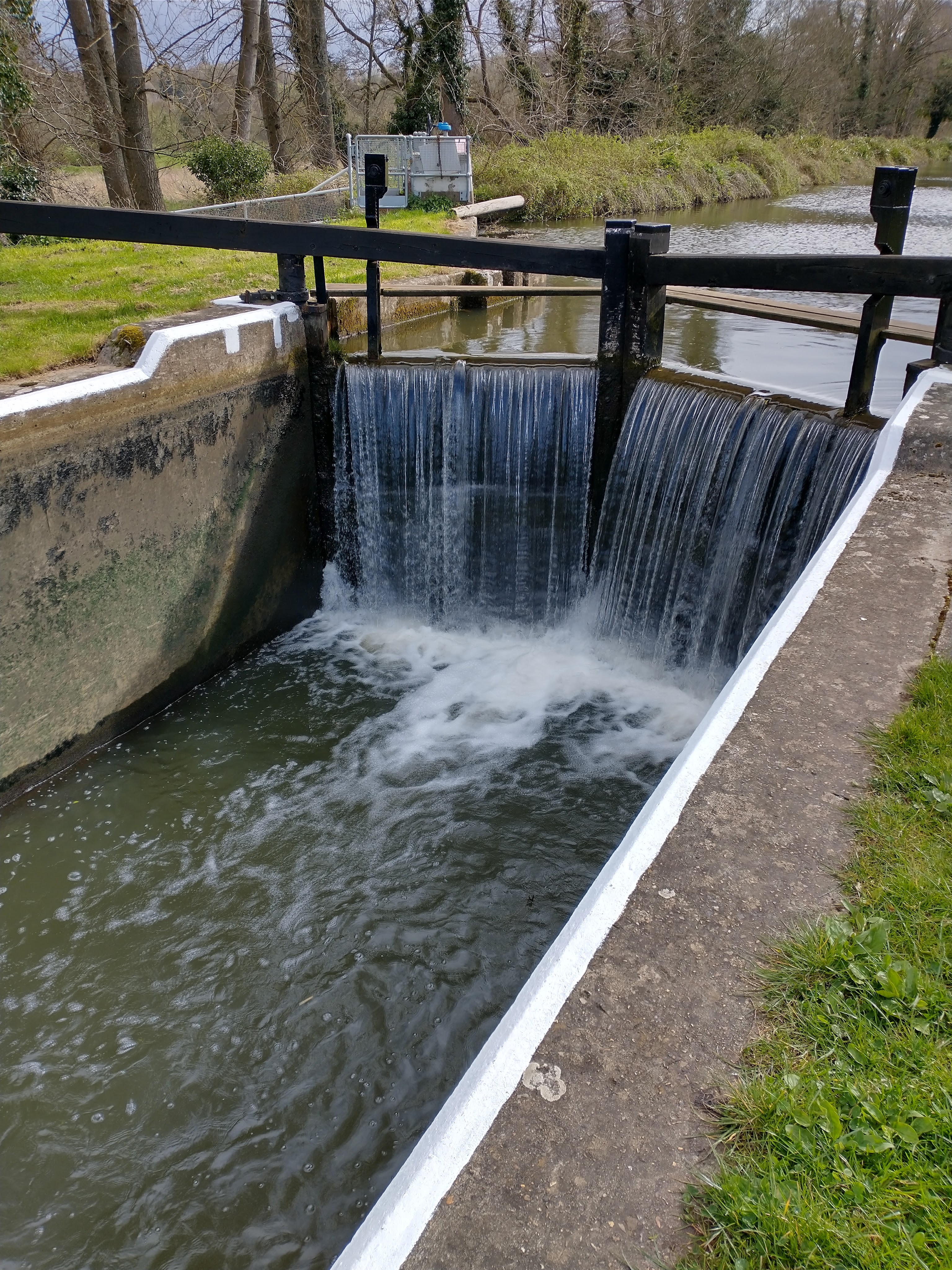
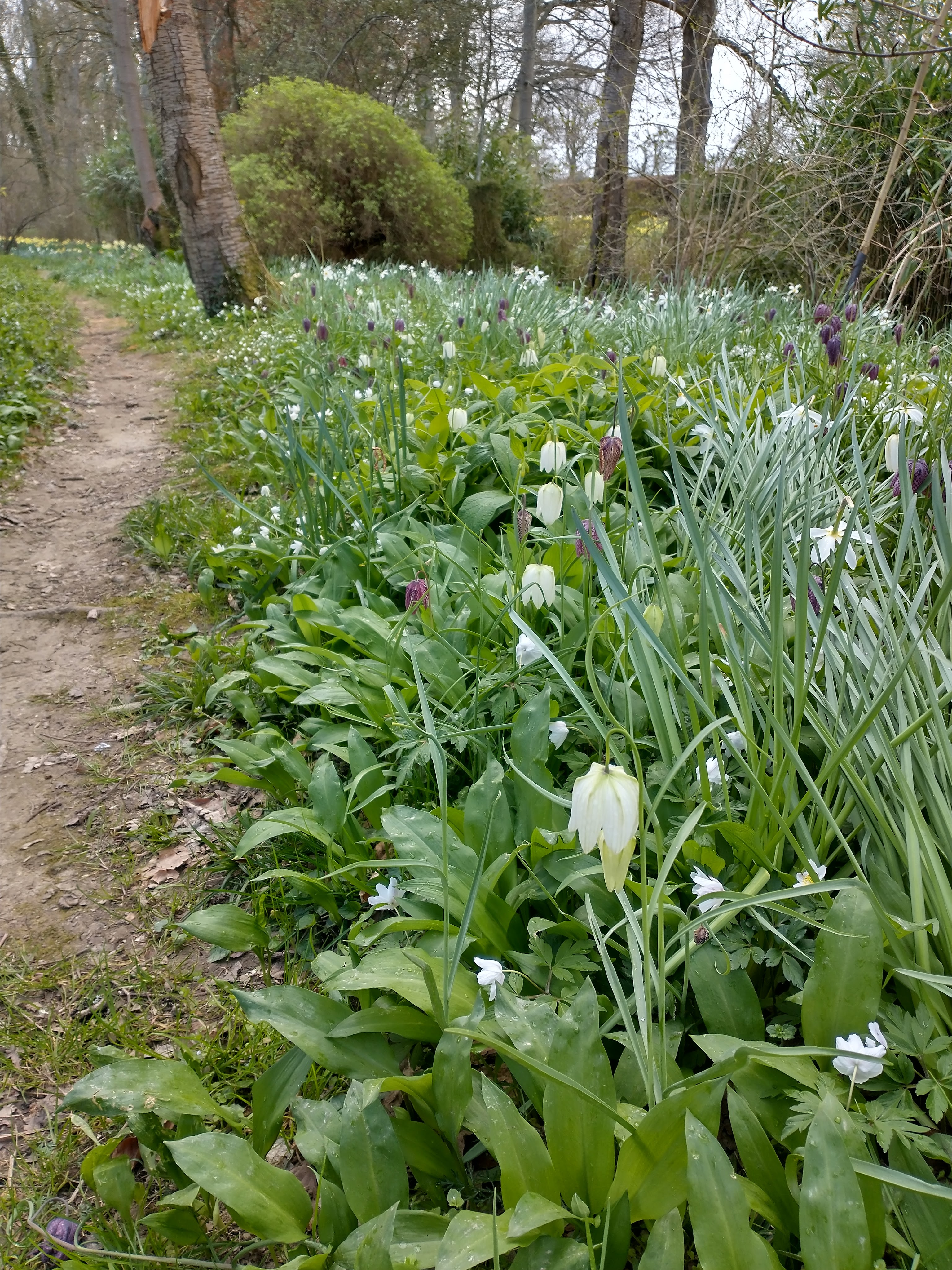
Look and See. What catches your attention? Here are some things which caught my eye three different local outings recently, two in gardens, one on the river Wey.
The subtle colours of the mossy rocks, and their shapes, against the leaf mould; the strong lines of the lock sides gates and the water pouring over the gates; the texture of the delicate spring flowers and the path receding away to …who knows where?
Start simple. All those things which apply to drawing small subjects indoors apply outside, it’s just on a different scale. You might start with drawing a detail – some leaves, some bark. If you’re drawing a scene, the trick is to focus on the larger aspects first – the large shapes, the colour contrasts, the textures and what marks might convey them. Make studies, not a finished drawing: get the composition right with a quick sketch of the large shapes; record the colour, either with colour swatches or notes about what colours are there; make some sketches of the details. This is drawing as a process, to learn about the subject.
Set a time limit. Draw for 10 minutes, to capture some element of what interests you. Draw for longer and you’ll have more time to investigate some other elements, as above.
I don’t really draw this fast….
Revist. If it’s local you can go back and look some more. There is always more to see; one reason for specialsing in a subject matter is because it takes time to truly see that subject and get to know it.
If you are anxious about being observed. A small sketchbook is very hard for others to look into. You can discourage looking with your body-language, hiding behind sunglasses or wearing a large hat! However, in my experience if anyone is curious, it is because thay have an interest in art and wish they could do it themselves. They might even be wishing they had your spirit of adventure to try.
Have you tried drawing outside? I would love to hear about your experiences: how was it? and perhaps what you drew, if you’re willing to share. Did any questions arise for you? Use the comments section below or send me a message via the contact form.





 Caroline Homfray