
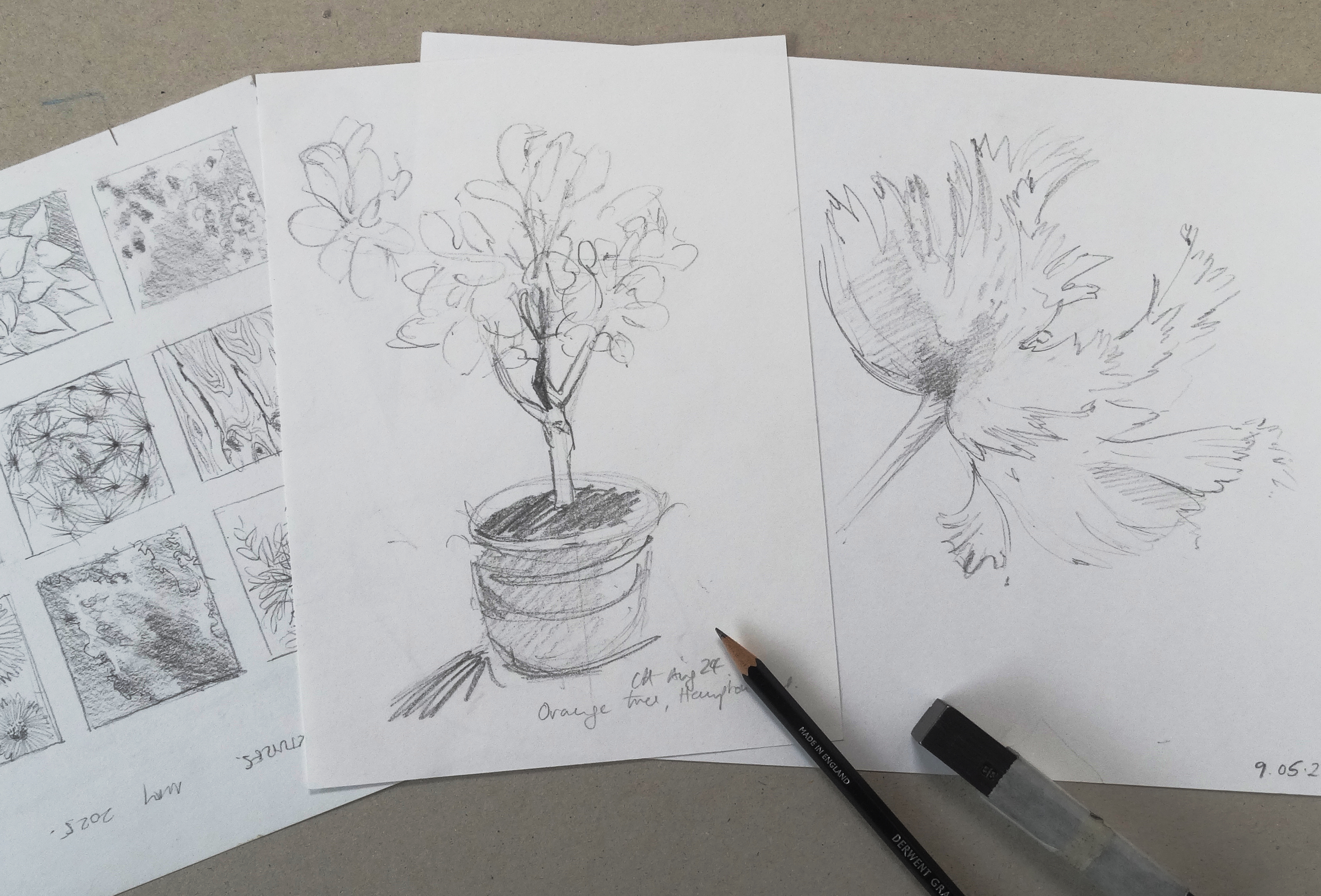
I’m about to start teaching again, and as I prepare for classes I’ve been pondering the reasons for drawing. This year I have taught drawing to both embroiderers and art groups, online, in webinars, visiting groups in person, and on location. As my teaching practice diversifies, I’ve also spent much time thinking and writing about drawing.
For the last nine years I’ve taught art and design for a very functional reason: as a tool for people wanting to produce their own designs for embroidery. There’s no doubt that whatever visual creative endeavour you’re engaged in, being able to draw it out really helps to work out what to do. Draw it out of your thoughts, bring it into being and adjust and play with it, and work out what it could be like with just a pencil and the back of an envelope or any other bit of paper to hand when an idea needs to be captured.(Here’s one of my favourite back-of-the-envelope workings out: the artist Holman Hunt’s sketch for his painting ‘The Light of the World’, in the collection of the Ashmolean museum, Oxford). This is using drawing as a tool, like writing can be, useful for working things out before deciding on a greater commitment of time, resources and effort.
However, if you can release the desire for an outcome, the process itself can become very engaging. As I carry my little sketchbook around (which sometimes I draw in and sometimes I don’t) I look at what’s around me in the moment and what I might want to note down. Looking back through these little books, many only the size of a postcard, I find architectural details drawing with care, a rapid sketch of someone in movement, observations of clouds, colour notes. These aren’t made for any particular purpose, but arise from curiosity about the world and how the energy of it or the essence could be captured.
On a recent trip away from home, with some time and space, I spent the evening looking at the sky and wondering how the clouds could be captured with lines. The sky was wide, the landscape flat, and the shape of the cloud system could be seen swirling around the changes of atmospheric pressures.
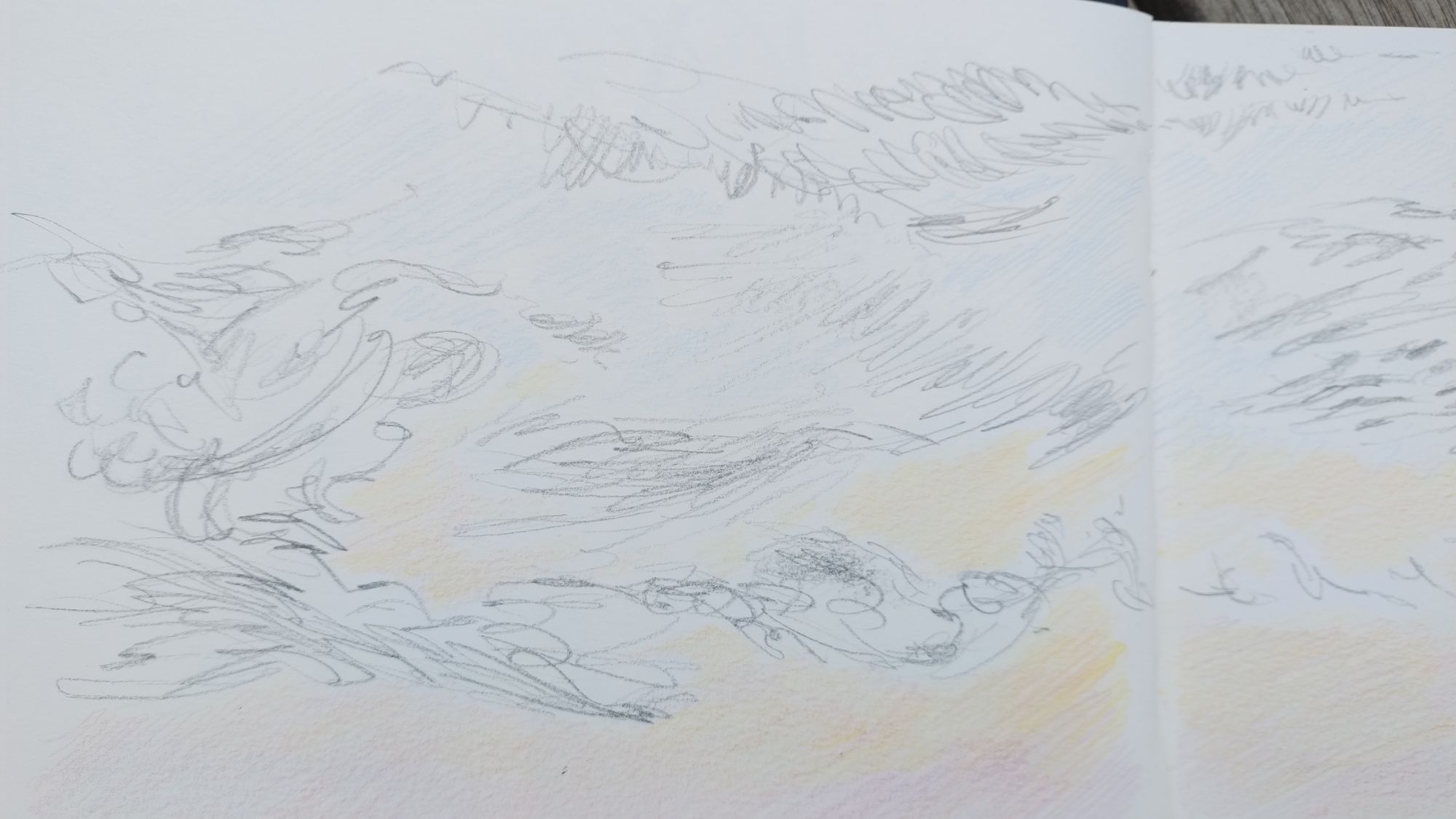
‘The world is a more beautiful place now’. ‘I’m seeing things in a different way’. ‘I’m noticing things more’. These are some of the comments I’ve most treasured from my students, as they’ve learned to draw; to look for shapes and spaces, play with lines and textures and find ways to express what matters to them.
For me that’s the key thing. Here are the tools, the materials, the methods; take them and find out what you want to do with them. Drawing is a language, and if you allow it, in a spirit of excitement and exploration, delightful and surprising things can emerge.
Whatever your motivation for wanting to draw, come and join me this Autumn.
Drawing for Beginners, starting on Wednesday 7th October.
Thursday Drop-in Drawing, starts 24th September.
Develop Your Watercolour Skills, starts 4th November

