
 Over the last four years I’ve been learning and then training as a Thinking Environment® facilitator. The cornerstone of the Thinking Environment is the principle that people can think well for themselves, given the right conditions. They involve being in the presence of a listener whose attention and encouragement is wholly yours, and who trusts completely that you are creative, altruistic, intelligent and can think for yourself.
That work, and delivering Thinking Environment and training for the NHS, researchers, undergraduates and local people at a regular community event I run with a colleague, has been slowly informing my teaching of embroidery, something else I fnd very rewarding. I’ve been pondering how could I make my classes more about the student discovering and exploring for themselves, and less about me leading from the front.
I started to introduce rounds, and ask people to share what’s going well, what’s their favourite sort of embroidery, what’s a project they’re proud of. Then, after a student volunteered some very useful feedback about what had been most helpful for her in learning the technique, I started to ask, what have you learned this morning that was most useful? what went well about today? what else would you like to see in the course?
Now I’ve started to ask myself, ‘how can I give them the experience of exploring and learning for themselves? How little information do I need to give, and what questions will stimulate their learning?’
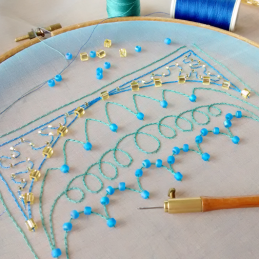
On Sunday I was teaching tambour embroidery at the Royal School of Needlework. We had a really fun, collaborative day with a relaxed atmosphere and everyone sharing their learning, questions, and tips from their own considerable textile experience. It felt easy as the teacher; I wasn’t tired or drained, but energised by the day. The participants reflected that they’d enjoyed the warm, friendly environment, and left with smiles and thanks.
So now I’d like to ask you. What are your best experiences of learning? what works for you? Please leave your comments below.
 I sat down with a good friend recently and we had a deep think about the difficulties of asking for help, whether it’s ok to lean on people or not, but how hard it is to engage with the world without the right structure or framework. We asked the question: What is support? Here’s our list, please feel free to add or discuss.
