Reasons to Draw.

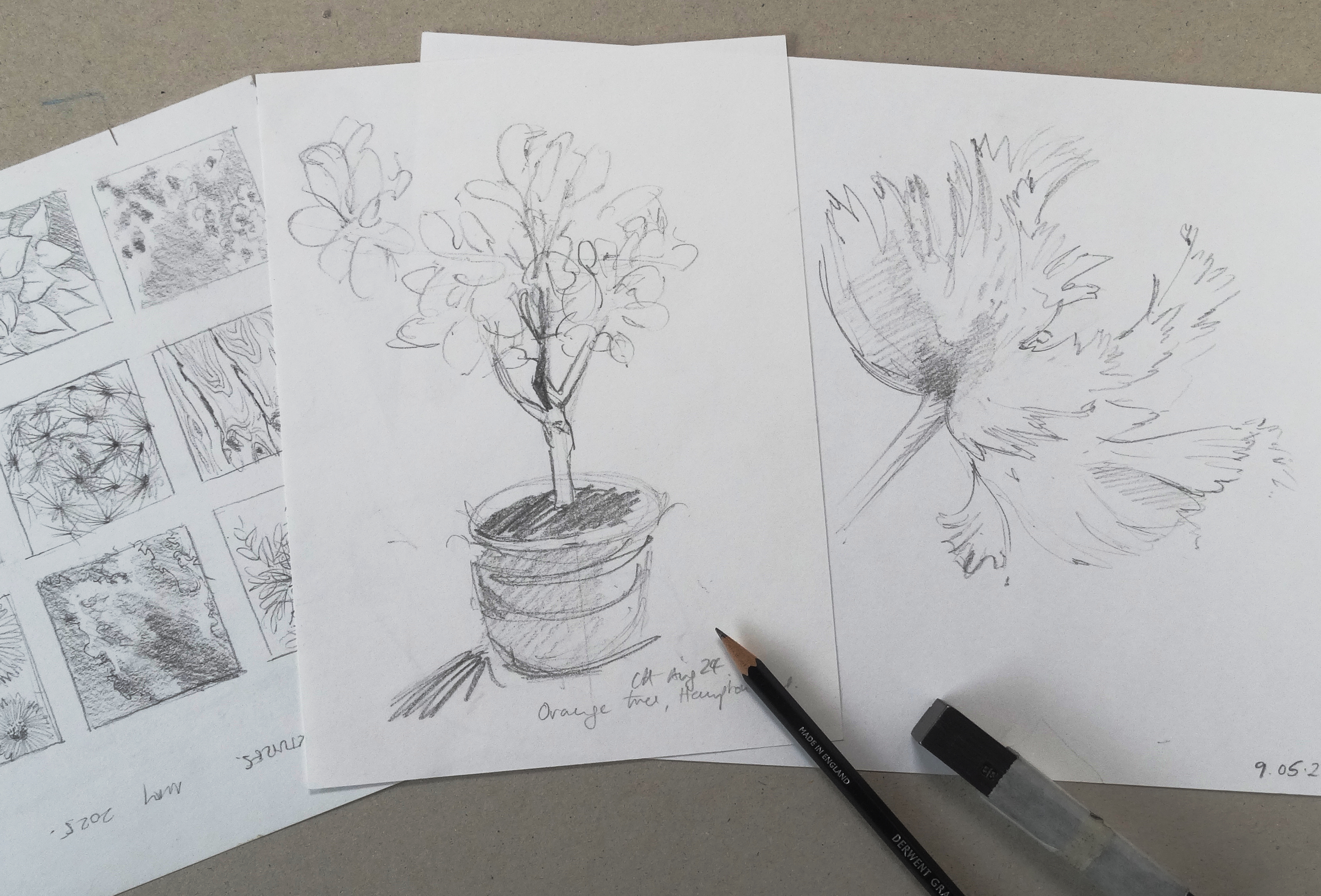
Drawing textures and outlines to capture the essence of things.

I’m about to start teaching again, and as I prepare for classes I’ve been pondering the reasons for drawing. This year I have taught drawing to both embroiderers and art groups, online, in webinars, visiting groups in person, and on location. As my teaching practice diversifies, I’ve also spent much time thinking and writing about drawing.

For the last nine years I’ve taught art and design for a very functional reason: as a tool for people wanting to produce their own designs for embroidery. There’s no doubt that whatever visual creative endeavour you’re engaged in, being able to draw it out really helps to work out what to do. Draw it out of your thoughts, bring it into being and adjust and play with it, and work out what it could be like with just a pencil and the back of an envelope or any other bit of paper to hand when an idea needs to be captured.(Here’s one of my favourite back-of-the-envelope workings out: the artist Holman Hunt’s sketch for his painting ‘The Light of the World’, in the collection of the Ashmolean museum, Oxford). This is using drawing as a tool, like writing can be, useful for working things out before deciding on a greater commitment of time, resources and effort.

However, if you can release the desire for an outcome, the process itself can become very engaging. As I carry my little sketchbook around (which sometimes I draw in and sometimes I don’t) I look at what’s around me in the moment and what I might want to note down. Looking back through these little books, many only the size of a postcard, I find architectural details drawing with care, a rapid sketch of someone in movement, observations of clouds, colour notes. These aren’t made for any particular purpose, but arise from curiosity about the world and how the energy of it or the essence could be captured.

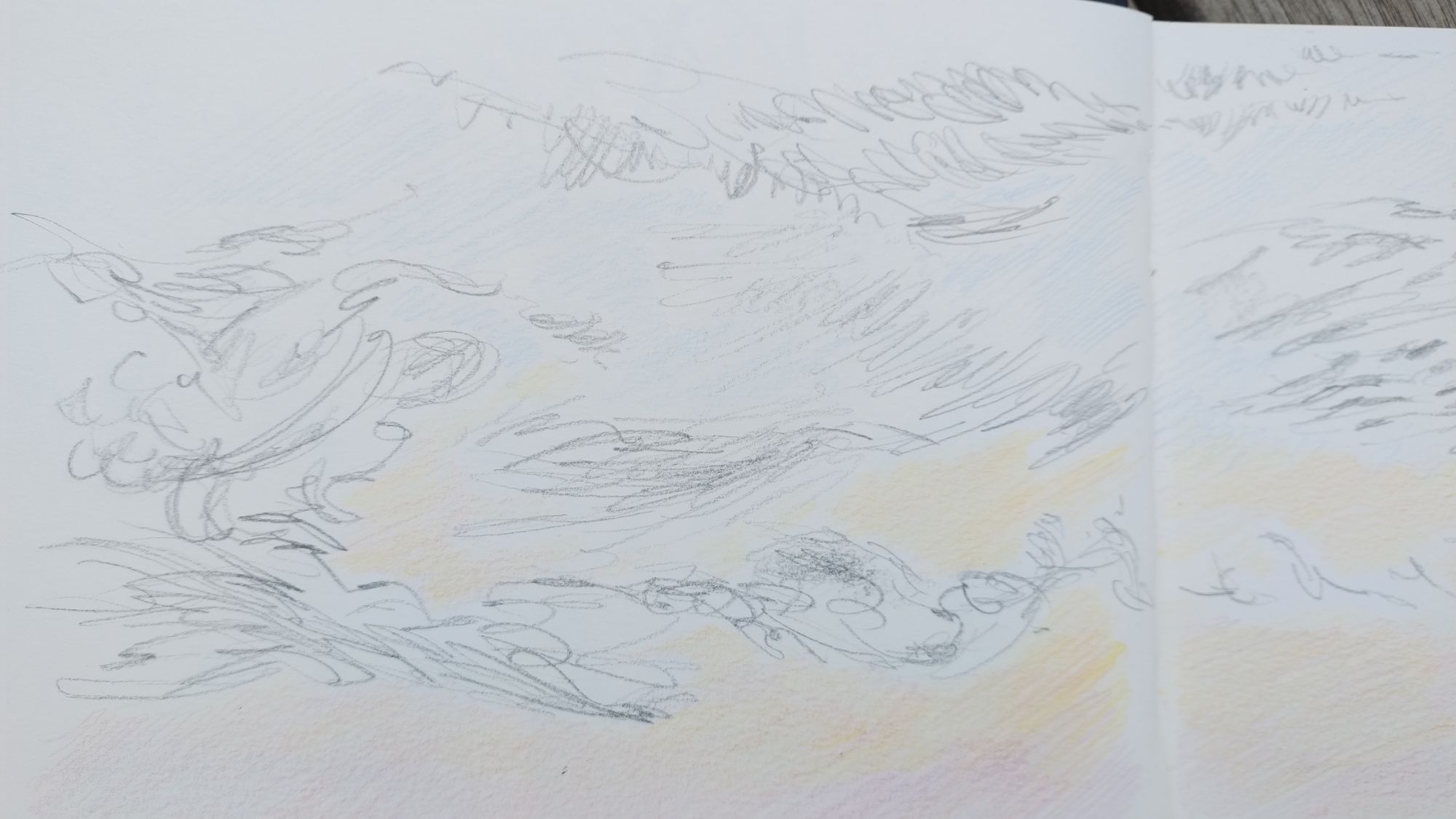
On a recent trip away from home, with some time and space, I spent the evening looking at the sky and wondering how the clouds could be captured with lines. The sky was wide, the landscape flat, and the shape of the cloud system could be seen swirling around the changes of atmospheric pressures.
img_20260922_09350317028517373046366267136.

‘The world is a more beautiful place now’. ‘I’m seeing things in a different way’. ‘I’m noticing things more’. These are some of the comments I’ve most treasured from my students, as they’ve learned to draw; to look for shapes and spaces, play with lines and textures and find ways to express what matters to them.

For me that’s the key thing. Here are the tools, the materials, the methods; take them and find out what you want to do with them. Drawing is a language, and if you allow it, in a spirit of excitement and exploration, delightful and surprising things can emerge.

Whatever your motivation for wanting to draw, come and join me this Autumn.

Drawing for Beginners, starting on Wednesday 7th October.

Thursday Drop-in Drawing, starts 24th September.

Develop Your Watercolour Skills, starts 4th November
On the usefulness of writing, for your own eyes only

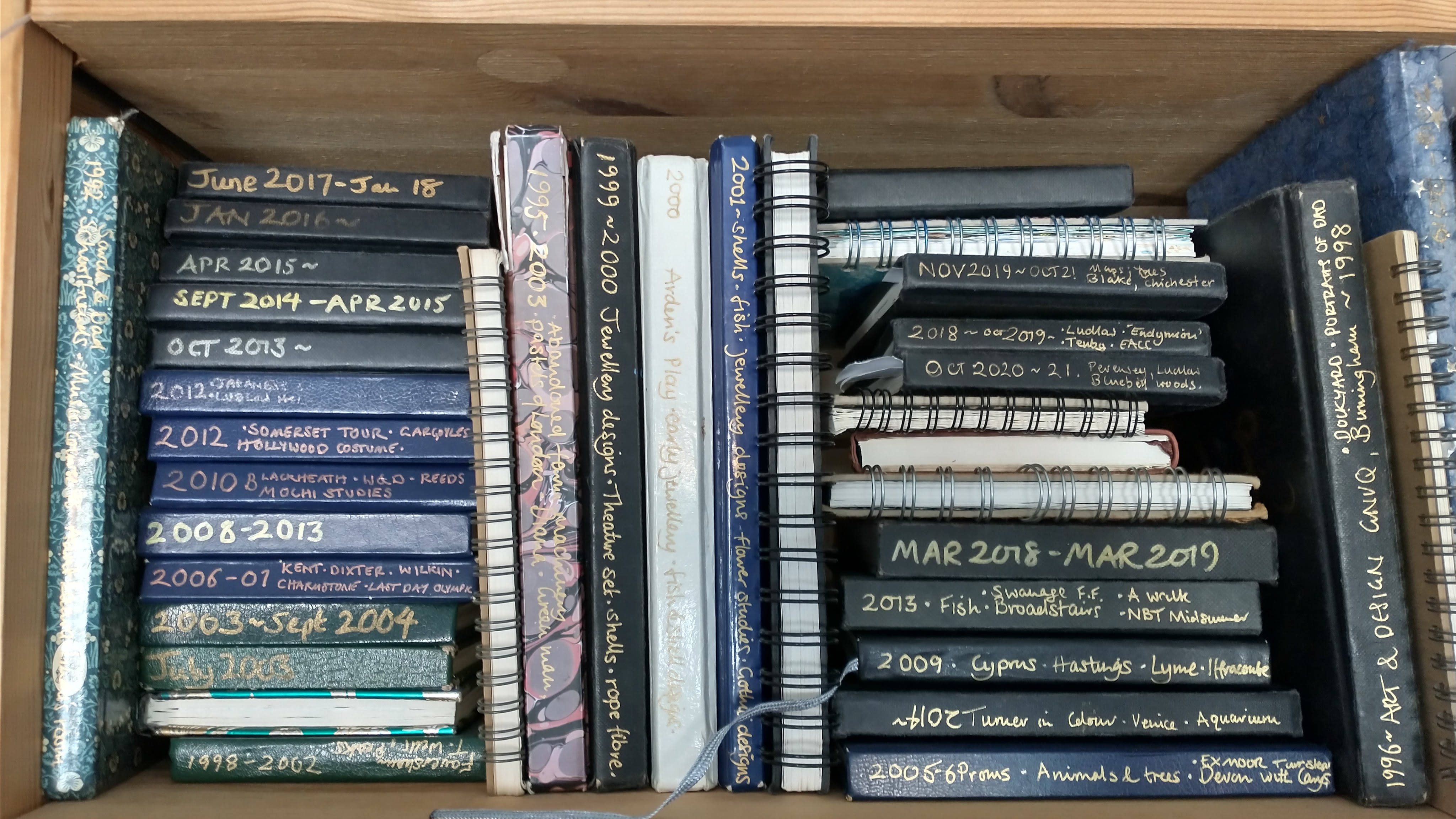
I effectively have two sorts of journalling: my sketchbooks which are very much drawn from and of the outside world, and written ones. There are lots more sketchbooks than written journals. The sketchbooks are on open shelves in my studio room, the journals are not. There are lots of drawings of places I’ve been, people I know (and sometimes people I don’t), some more detailed studies, rapid lines taken during a concert, studies made in museums, and sometimes written notes; it’s a place to record, remember and gather for future use. People look through my little sketchbooks sometimes but that’s ok because I don’t think they contain anything secret or controversial that I don’t want anyone to see. Most of the drawings were done in public anyway.

The journals are different. They are messy, written with no concern for spelling or grammar, not organised and sometimes illegible. These are not pretty journals; there’s no artwork or colour. Page after page of inky scrawl, which if you could unravel it, would be miles and miles of blue black thread which would probably go around the earth a few times. Often I write in a stream of consciousness which just goes wherever it needs to, and sometimes in more structured way around a question or a idea which has emerged. I write down reflections about my artwork: what I’ve tried and what I want to do next, which really helps me to pick it up again after a gap.

Sometimes I’m just dumping thoughts. I read them back later and that gives me some objectivity. It turns out that being able to do this for yourself has the added benefit of protecting your relationships from the strain of oversharing negative emotions (Kross, Chatter – The Voice in Our Head (and How to Harness It) p31, Vermillion 2022) without tiring the empathy of listeners.

I can then review it, giving myself the chance to consider it with some distance. Are there any negative assumptions underlying my reactions to something? Is there a different, more enabling way I could see it? What are the options for response, if any? Or do I need to just accept it?

Sometimes, on re-reading, I can find insights. if I repeatedly write about a problem, it flags up that there really is something I need to address. Coloured pencils come in for a bit of highlighting, things that pop out as important.

It’s also useful to write sometimes in a deliberate attempt to find the positive.What’s gone well today? what did I particularly enjoy, however small, or what am I grateful for? That can give me something to focus on when I wake up in the small hours ruminating.

Researchers are finding evidence of all these benefits in the practising of writing reflectively about one’s own experiences. It’s one of the practises being offered by Laura and myself on the Retreat Day we’re running next March. So if it’s new for you, give it a go and see how it changes things.

A few things to try:

  • setting a timer and writing in a stream for, say, 15 minutes.
  • writing down what you feel grateful for.
  • writing about an experience; who was there, what did you see, hear, smell, taste; what did you feel, what happened? Try writing it as if in the third person. Imagine you are observing yourself.
  • finding some affirmations and writing them down. This is very literally telling yourself that you’re worthy, deserving of love and affection, are capable, have talents – whatever it is that you need to hear to feel more safe, secure and supported, especially in areas where you feel vulnerable.
  • look up some journalling prompts. Specfic questions like: what behaviours do I want to grow? what do I want to stop doing? What new thing would I like to try? Who gives me support?

Research also shows that the benefit are felt over time, and that you don’t have to write every day to feel them. The important thing is to choose a way that suits you, and keep it private.