

Do you have lots of UFOs lurking? PHds? Unfinished objects, projects half done… and does it matter? After a few terms of experimenting and trying lots of different processes, the students in my weekly drop in drawing class have a lot of work which may or may not be ‘finished’. I’ve written before about the process of reflection in creating artwork. Is this a case of reviewing the work, reflecting on what’s been done and then adjusting or adding to it til it’s complete?
Depends what you wanted to achieve. Sometimes when creating it’s about working out through the process what works, and equally importantly, discover what doesn’t work in order to change it – or discard the first attempt (or the second, or third…). The drawing/designing and making process is different to the mode you need to be in when you evaluate something; you need a bit of distance from your creation to see it objectively. Distance can be literally holding it at arms length, or it can be time. Put the work on the wall for a while and look at it now and then, or get it out of its folder or open the sketchbook and have a look through later, when a few days, weeks or years have passed. If you can introduce this discipline of periods of reflection, and then revisting your work, things might move forward in a way you don’t expect. If you’re the sort of person who likes a folder full of completd things this might be uncomfortable! It might mean making yourself stop before it’s finished and give some time for the image and your ideas to be assimilated and coalesce.
I have a piece of work currently sitting on an easel because I dont know what it needs next – but if I wait, and look at it ocasionally, that might become apparent. It’s been through a few of these hiatuses already. I have other work that I might just leave as it is, half done and not looking like a finished thing. It might get re-used in some way or ultimately binned (pulped and remade by the borough rubbish collection service), or burned. At the moment for me it feels important to let myself not worry about making finished things. I am just beginning to feel like finishing one or two. And others I might like to try that process again…
How do you know if it’s finished? Give your work a bit of love. Try putting some L-shaped pieces of mountboard around it and see how it looks, given the honour and care of a frame. The only difference between a drawing shoved in a folder and a piece of art on the walls of a gallery could be your attitude, and a carefully chosen frame. Remember to sign and date it. (You can make up the date if you’re not quite sure…)
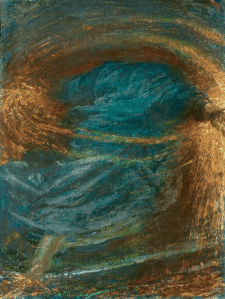
Sower of the Systems, 1902. GF Watts.
Watts Gallery Trust.
Finished? There’s no reason to suppose Watts thought it was anything other than complete, but… imagine yourself in front of this painting, still wet with paint, brushes in hand. Would you have stopped here?
GF Watts took decades to work on some of his paintings. He would return to them and alter them over long periods of time. The (admittedly enormous) ‘Court of Death‘ was started in 1870 and finished in 1902.
Picasso made 58 versions of the painting Las Meninas by Valezquez, each one exploring different aspects of the picture. Each one is finished, but there was still more to explore.
Even when you think you’ve finished, it might only be one part of a bigger idea.
 Caroline Homfray
A timely and thought-provoking read, as ever, Caroline. I recognise that process of mindful watching and waiting, the clarity that comes from a period of letting work alone. I’m loving the idea at the moment of art being a practice and not a commodity – a process rather than a finished, saleable entity 🙂
I find it becomes impossible viewed as a saleable thing, thsat so easily becomes paralysing. I wonder if an artist like Watts ever really though anything was finished or just decided to move it along. I went through a phase of automatically binning everything to save myself from worry about the outcome. I also had a big bonfire of drawings – that was fun! Music is a good teacher for me of non-attachment – the notes are gone within seconds, which is a great relief when practising. Imagine if they all solidified and fell to the floor around you as you played…horrific!